
INDEPENDENT CLEARANCE TESTING · TDLR ACO1245
Selling a home? Closing an insurance claim? Moving back in after remediation? Texas law requires an independent, TDLR-licensed assessor to verify the work, separate from whoever performed it. Mold Testing Houston tests, analyzes, and delivers your written result in 24 business hours.
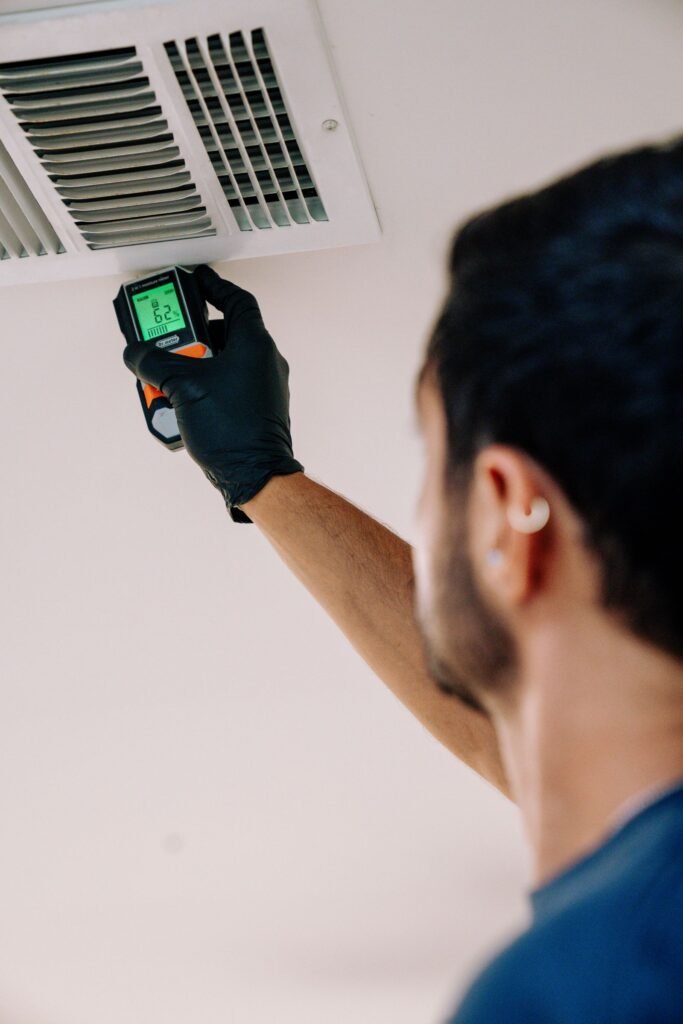
TDLR-licensed Mold assessor taking a temperature and humidity reading at a ceiling air vent during a post-remediation clearance test in Houston.
Mold clearance testing is an independent inspection and lab analysis that confirms a remediation actually worked and the space is safe to re-occupy. It is also called post-remediation verification or post-remediation testing. Rather than trusting that an area “looks clean,” a clearance test documents what is actually in the air and on the surfaces, then compares your indoor results against the outdoor baseline and the clearance criteria in your mold remediation protocol.
Clearance testing is a measurement, not a judgment call.
A passing result means the space has returned to what the IICRC S520 standard calls Condition 1, or Normal Fungal Ecology: indoor mold levels back in line with the clean air outside. That is the line between assuming the problem is solved and proving it.
Texas requires that this verification come from a TDLR-licensed Mold Assessment Consultant, and from a different company than the one that performed the removal. That separation is what makes the result mean anything.
One visit, one day, and a signed clearance certificate in hand, here’s exactly what happens.

We review the original remediation protocol, confirm the work area is dry, ventilated, and ready for testing, and verify no new contamination is visible.

We collect calibrated air samples inside the remediated area and one outside as a baseline. Surface swabs are taken anywhere the protocol calls for verification.

Samples go to EMSL Analytical, an AIHA-LAP EMLAP-accredited microbial lab. Spore types and concentrations are identified and compared against the outdoor baseline.

You receive a written clearance report (pass or fail) within one business day of lab results, formatted for your insurance company, lender, or buyer.
Most people don’t realize the company that removes their mold legally can’t be the one that clears it. That isn’t red tape, it’s a consumer protection, written to keep you from having to accept a “pass” from the same company you just paid to make the problem go away. It’s the same reason you wouldn’t let the dealer selling you a used car be the one to inspect it: when someone has a stake in the result, only an outside check carries weight. That separation is the whole reason independent testing exists, and the whole reason your result can be trusted.
Under Texas Administrative Code Chapter 295 and the Texas Mold Assessment and Remediation Rules, the company that removes the mold cannot also perform the clearance test on the same project. The roles are split on purpose, to remove the conflict of interest.
Texas requires that mold assessments and clearance testing be performed by a TDLR-licensed Mold Assessment Consultant. Our clearance reports are signed off under MAC1839. A cleanup crew's own sign-off is not a clearance, no matter what the paperwork is called.
Mold Testing Houston (TDLR ACO1245) is barred from performing remediation, and we don't sell cleanup. So when we say the air is clear, it isn't a setup for another invoice. Your insurer also gets what it usually requires: a third-party clearance certificate rather than one written by the remediator.
Our reports are built for insurance adjusters, real estate closings, and legal disputes: lab-analyzed results, a licensed assessor's sign-off, and the outdoor baseline comparison that holds up under scrutiny.
Mold clearance testing isn’t always necessary, and we’ll be the first to tell you when it isn’t. Whether it’s required comes down to your situation. Here’s the breakdown.
Two outcomes, and a clear next step for each. A failed clearance test isn’t a disaster; it just means the work isn’t finished yet, and you’ll leave with a plan for exactly what’s left.
Indoor spore counts in the remediated area are at or below the outdoor baseline. The remediation worked, and you receive a signed clearance certificate to submit to your insurance company, lender, buyer, or attorney.
What happens next: The space is cleared to reoccupy. Keep the certificate for your records and any future disclosure requirements. In Texas, you may need it when selling within five years.
Indoor spore counts are still elevated, or new contamination turned up. The remediation didn't fully resolve the issue. But a fail is not just a fail: your report lays out exactly what is still present, where it is, and a step by step plan for what needs to happen to reach clearance.
What happens next: You receive a detailed corrective plan, effectively an updated protocol, that is usually shorter than the original since most of the work is already done. Your remediation contractor uses it to address the specific areas flagged, typically under their warranty, and then we retest against the same independent standard. We tell you what the data shows and hand you the plan to fix it. We do not recommend a remediation company, that stays your choice.
No hidden fees, no vague “it depends.” Here’s exactly what an independent clearance test costs, and what’s included for that price.
Anyone can claim to be independent. Mold Testing Houston (MTH) puts the license numbers, the accredited lab, and the years of experience behind it, right here in writing, because a result is only as good as the people and standards behind it.
Your clearance test is performed and signed by Ran Bozaglo, a TDLR-licensed Mold Assessment Consultant (MAC1839), under company license ACO1245. A real, licensed name on your report, not an anonymous technician.
Samples are analyzed by EMSL Analytical, an AIHA-LAP EMLAP-accredited laboratory, completely independent of MTH. The accreditation is the mold-industry standard; the independence is what makes your result defensible.
MTH has tested Houston-area properties since 2017, and has never performed remediation. Nine years of doing one thing, verifying whether mold is actually gone, with no cleanup business pulling the result either way.
Every clearance test is measured against the IICRC S520 standard the State of Texas points to, comparing indoor spore levels to the outdoor baseline. The same objective benchmark, every job.
STILL HAVE QUESTIONS?
Clear answers to the most common clearance testing questions, from cost and turnaround to what a failed test means.
The on-site visit usually takes one to two hours, depending on the size of the remediated area and how many samples are needed. Your samples then go to the lab, and Mold Testing Houston delivers your written clearance report within one business day of testing. That turnaround matters when a closing or an insurance claim is on a deadline.