Almost everything written about this tells you to change the filter, pour vinegar down the drain line, and buy a foaming coil cleaner. That advice is not wrong. It is just the answer to a different question than the one most people are asking.
The question is not how to clean an air conditioner. It is what the smell is telling you.
Mold Testing Houston is assessment-only under TDLR license ACO1245 and has been since 2017. We do not service air conditioners, clean ducts, or perform remediation. What we do is find out where a smell is actually coming from, which is a different job from making it go away.
What the Smell Actually Is
Your evaporator coil gets cold. Warm humid Houston air passes across it, water condenses on the fins, and that water drips into a pan and out through a drain line. That is the system working correctly.
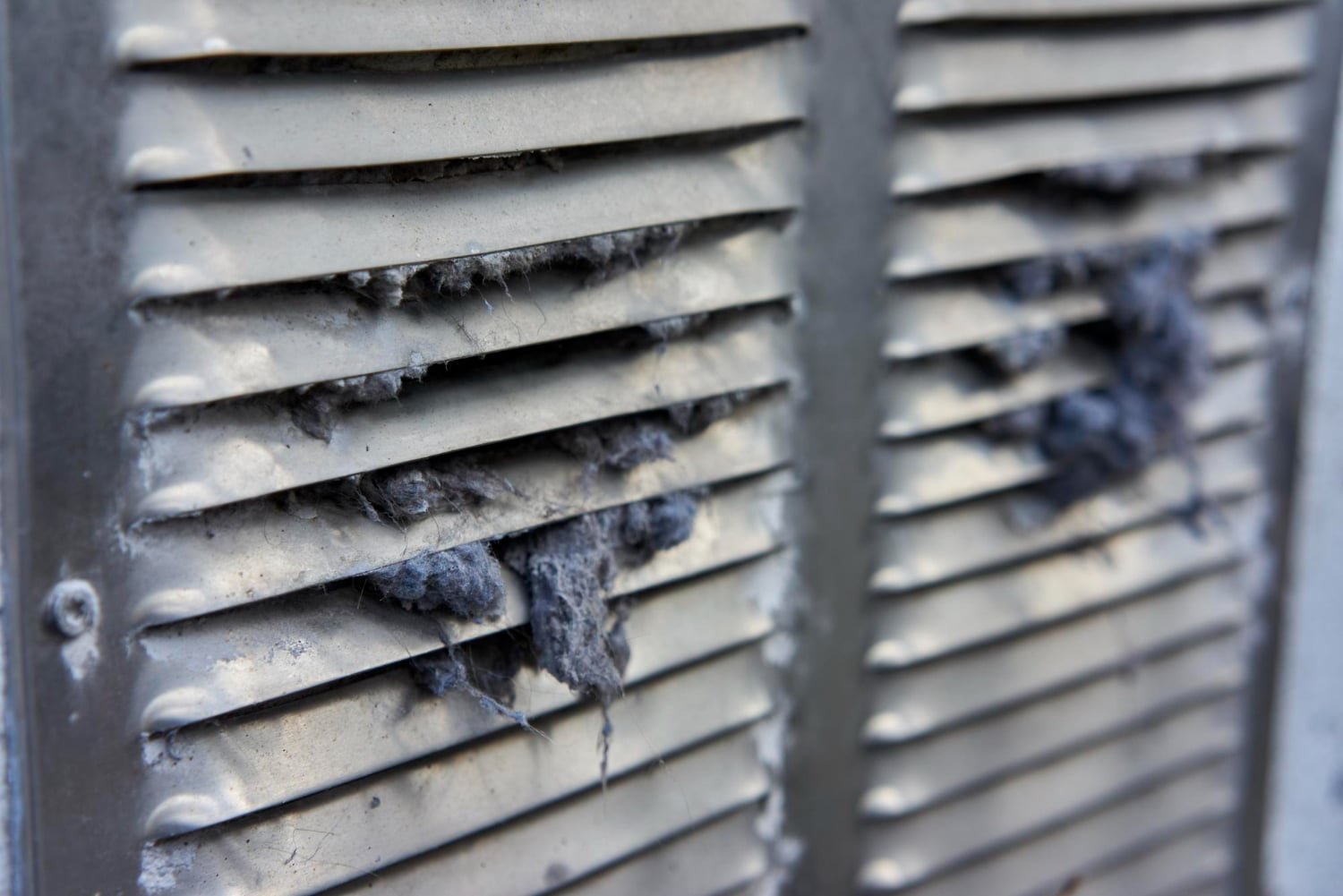
It also means there is a permanently damp, dark, dust-collecting surface inside your air handler for most of the year. Organic dust lands on a wet coil, microbial growth follows, and the air you breathe passes directly over it every time the system cycles.
That is the common case, and it is a maintenance problem rather than a building problem. Where it stops being simple is when the smell is not coming from the equipment at all.
The Test That Tells You Which One You Have
Three observations, none of which require any equipment, and together they narrow it considerably.
Does it happen on heat as well as cooling?
If the smell only appears when the system is cooling and never when it is heating, that points at the coil and the condensate system, because those only get wet during a cooling cycle. If the smell shows up on both, or shows up with the fan running alone in circulate mode, the air is picking something up on its way through the ducts rather than at the coil.
This is the single most useful observation you can make and it costs nothing. In Houston you may have to wait for a cool morning to test the heat side.
Is it every vent, or some of them?
A smell coming out of every supply register points upstream, at the air handler or the plenum, because that is the one place all the air passes through. A smell from one or two registers points at those specific duct runs, or at whatever those runs pass through on their way to the room.
Does it fade after a few minutes or stay?
A burst of odor in the first minutes of a cycle that then clears usually means moisture sitting on the coil is being driven off as the system runs. A smell that persists the entire time the system runs means it is being supplied continuously, which means a source rather than a residue.
Where to Look First
Four places, in the order a professional checks them.
- The drip pan. Standing water, slime, or discoloration. A pan with water still in it hours after the system stopped means the drain line is not clearing.
- The evaporator coil. Growth on the fins, or on the insulation lining the plenum around it. This is the most common source and the one coil cleaner is meant to address.
- The drain line and its termination. A clogged line backs water into the pan. Where the line ends also matters, because a primary line that has quietly stopped draining sends water to the secondary pan and the overflow, and both of those are places nobody looks.
- The attic around the unit, if the air handler is up there. This is the one that gets missed. A slow drip into fiberglass insulation can saturate a several foot radius without ever showing up at ceiling level, and attic conditions in a Houston summer are about as favorable for growth as it gets.
When It Is Not the Air Conditioner
Here is the part the maintenance articles skip.
Your air handler does not only push air out. It pulls air in, through return ducts and return plenums that run through wall cavities, ceiling chases, and attics. If any part of that return path passes near or through something that is growing, the system picks up the odor and distributes it to every room.
The smell arrives when the AC starts because the AC is what moves the air. That does not mean the AC produced it.
Three situations where this is what is happening:
- A previous leak nobody connected to the smell. A roof leak, a supply line failure, or a window that leaked during a storm. The visible damage got repaired and the wall cavity did not.
- Return ducts running through a humid attic. Uninsulated or poorly insulated metal ducts in unconditioned attic space develop condensation on the outside when cool return air meets hot humid attic air. Whatever grows on that surface sits directly in the air path.
- A bathroom exhaust fan venting into the attic instead of outside. Common in older Houston homes and worth ten seconds to check. It puts humid air into a space that is already humid, right next to the ductwork.
The practical consequence: if a coil cleaning made the smell go away for two weeks and then it came back, the coil was not the source. It was the surface closest to you.
Should You Turn the System Off?
If you can see growth in the air handler or the plenum, yes, until it is inspected.
The EPA’s guidance on air duct cleaning advises against operating an HVAC system suspected of mold contamination, because the system distributes spores through the building rather than containing them. That is a real consideration and no HVAC manufacturer’s blog is going to lead with it.
The EPA is also direct about a related point: insulated ducts and plenum liner that have become wet or moldy cannot be effectively cleaned and should be removed and replaced. A duct cleaning quote that proposes cleaning wet fiberglass liner is proposing something that does not work.
Practical version for Houston in August: if you cannot turn the system off, at minimum stop running it in fan-only circulate mode, which moves air across the coil without dehumidifying and tends to make the problem worse.
Why the Duct Cleaner Cannot Answer This
Two reasons, and only one of them is about incentives.
The first is legal. In Texas, mold assessment is a licensed activity. Taking samples to identify mold or evaluating whether a mold problem exists requires a TDLR Mold Assessment Consultant license. HVAC technicians and duct cleaning companies do not hold it, which means they can tell you what they see and they cannot issue findings on mold.
The second is structural. A duct cleaner who concludes you have mold in your ducts is quoting you for the cleanup in the same conversation. That is not an accusation of dishonesty, it is a description of the arrangement. Texas separates assessment from remediation for exactly this reason.
If someone has told you that you definitely have mold and their cleaning service will fix it, an independent test settles it in one direction or the other. If there is growth, you get a documented scope so the work is defined before you pay for it. If there is not, you have avoided a cleanup you did not need.
When Testing Is Worth It
Not always. If the smell is confined to cooling cycles, the drip pan has standing water in it, and a proper coil and drain service clears it for good, you found your answer and you do not need us.
Testing earns its cost when one of these is true:
- The smell came back after the coil and drain were serviced
- It appears with the fan alone, or on heat as well as cooling, which points away from the coil
- There is visible staining on a ceiling below an attic air handler, meaning water escaped and went somewhere
- The air handler is in the attic and a leak ran long enough to soak insulation
- You are selling the home, or documenting a claim, and need something in writing
Our broader guide to that decision is at do you need a mold test. If the smell traces back to the attic rather than the equipment, Houston attic mold covers what tends to be going on up there.
What an Assessment Actually Checks
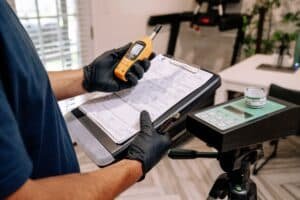
One to two hours. Visual inspection of the air handler, plenum, drip pan, drain line and accessible ductwork, plus the attic space around the unit if that is where it sits. Moisture readings on the ceiling and wall materials below and around it. Thermal imaging to find moisture still present where nothing is visible.
Then air samples, including one taken at a supply register while the system runs and one from the affected room, both compared against an outdoor control taken the same day. That comparison is the part that makes a spore count mean anything. Surface samples go on any visible growth. Our guide to indoor air quality testing in Houston explains how that comparison works.
Samples are analyzed by EMSL Analytical, an AIHA-LAP accredited laboratory with no financial relationship to us. Results come back in one business day, so a Friday inspection means Monday results.
What you get is a written answer to the actual question: is the equipment the source, is the equipment the delivery route, and what needs to happen about it.
Frequently Asked Questions
Why does my house smell musty when the air conditioner is on?
Because the air conditioner is moving air, and the air is passing over something growing. Most often that is the evaporator coil or the drip pan, both of which stay damp through a Houston cooling season. Sometimes the system is only the delivery route, picking up an odor from a return duct that runs through a wall cavity or attic where something else is growing. Whether the smell also appears on heat, or with the fan running alone, is the fastest way to tell those apart.
Does a musty smell always mean mold?
Not necessarily mold specifically. A musty odor means microbial growth, which can be mold, mildew, or bacteria, and the smell alone does not distinguish between them. It reliably tells you moisture is sitting somewhere it should not, and that is worth chasing regardless of which organism is responsible. What the smell cannot tell you is how much there is or where it is, which is why an odor is a reason to look rather than a diagnosis.
Why does my room smell musty when there is no visible mold?
Because most growth is not where you can see it. Wall cavities, the back side of drywall, subfloor, attic insulation, and the inside of ductwork all sit outside your line of sight. A musty smell with nothing visible is the most common legitimate reason to test the air rather than keep looking, because you have a signal and no source.
Should I turn my AC off if it smells musty?
If you can see growth in the air handler or plenum, yes, until it is inspected. The EPA advises against running an HVAC system suspected of mold contamination because the system distributes spores rather than containing them. If shutting off completely is not realistic in a Houston summer, at least stop using fan-only circulate mode, which moves air across a damp coil without removing humidity.
Will the musty smell go away on its own?
Only if the moisture does. Smell is a symptom of an active condition, so it fades when the condition stops and returns when it resumes. A smell that disappears in winter and comes back every spring is telling you the cooling cycle is creating the conditions, not that the problem resolved. A smell that returns weeks after a coil cleaning is telling you the coil was not the source.
Can a duct cleaning company test for mold?
Not in Texas. Mold assessment, including sampling to identify mold or evaluate a mold condition, requires a TDLR Mold Assessment Consultant license. A duct cleaning company without that license can describe what it sees but cannot perform testing or issue findings on mold.
Will replacing the AC unit get rid of the smell?
It will if the old coil or pan was the source. It will not if the source is in the ductwork, a wall cavity, or the attic, because a new air handler pulls through the same return path as the old one. Replacing equipment before identifying the source is an expensive way to test a theory, and it is worth ruling out the cheaper explanations first.
Find Out Where It Is Coming From
If a musty smell arrives with your air conditioning and a coil cleaning did not end it, the useful next step is finding the source rather than treating the symptom again.
Mold Testing Houston operates under TDLR license ACO1245 and performs assessment and testing only. We do not service HVAC equipment, clean ducts, or perform remediation, so we have nothing to sell you on the back of what we find. A flat $550 mold inspection in Houston covers the air handler and surrounding materials, moisture readings, thermal imaging, air and surface sampling against an outdoor control, EMSL lab analysis, and a written report in one business day.
If the report shows remediation is needed, we write the remediation protocol and you hire any licensed contractor you choose to follow it.
Book online, call 832-838-9387, or contact us and describe when the smell shows up.