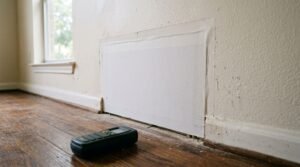

What happens if you never remediate mold is a question about the building before it is a question about anything else. Mold is a decomposer. Its function in nature is to break down organic material, and indoors the organic material is your house.
The EPA puts it directly: molds gradually destroy the things they grow on. That process does not pause because nobody is looking.
Mold Testing Houston has been assessment-only since 2017 under TDLR license ACO1245. We do not perform remediation, so this guide has no cleanup to sell you.
What Untreated Mold Does to a Houston House
Damage follows the material, and Houston homes concentrate the vulnerable material in three places.
Roof decking and framing
Attics are where this shows up most here, because most Houston homes put the air handler upstairs and attic temperatures pass 140 degrees while humid air meets decking that cooled overnight.
Plywood sheathing under sustained moisture softens, delaminates at the plies, and loses its ability to hold a fastener. Rusted nail points are the early signal, since they mean moisture has been condensing on metal repeatedly. Decking is structural, so degradation there is a building problem regardless of whether anyone is breathing spores. Our guide on Houston attic mold and why quotes vary so widely covers the cycle in detail.
Subfloor and the bottom of walls
Slab leaks feed this one. Water surfaces through the concrete, travels sideways along the seam where the slab meets the bottom plate, and sits in the lowest six to eighteen inches of drywall and in the plate itself.
Left alone, that produces soft baseboards, separated trim, and eventually subfloor that flexes underfoot. The repair stops being drywall and becomes carpentry.
The HVAC system
This is the one that turns a local problem into a whole-house problem. Growth in an air handler or in ductwork gets distributed everywhere the system blows, which means material in rooms that never had a moisture problem of their own.
The EPA advises not running an HVAC system you know or suspect is contaminated, because it can spread mold throughout the building.
What the EPA and CDC Say About Exposure
We are a mold assessment company and not a medical provider, so this section reports what the agencies publish rather than making claims of our own.
The EPA states that molds have the potential to cause health problems. According to that guidance, molds produce allergens, irritants, and in some cases potentially toxic substances called mycotoxins. Inhaling or touching mold or mold spores may cause allergic reactions in sensitive individuals, including hay fever type symptoms such as sneezing, runny nose, red eyes, and skin rash. The EPA notes that molds can trigger asthma attacks in people with asthma who are allergic to mold, and that exposure can irritate the eyes, skin, nose, throat, and lungs of both allergic and non-allergic people.
The EPA is also explicit that its guidance is a brief overview rather than a complete account of potential health effects, and it directs readers to consult a health professional. The CDC likewise recommends speaking with a health care provider about symptoms.
If someone in your household has symptoms, that conversation belongs with a physician. What an assessment can tell you is whether elevated spore levels are present in the building and where they are coming from, which is a different question and a useful one for a doctor to have an answer to.
How Fast Does Mold Spread in a House?
Growth can begin on wet material within 24 to 48 hours, and the EPA advises drying water-damaged areas within that window to prevent it. In Houston the practical window is shorter, closer to 36 hours, because heat and 75 percent ambient humidity compress it.
After that first window, the pace depends entirely on the moisture. A wall cavity that stays damp spreads over days to weeks, following the water rather than expanding evenly. Paper-faced drywall and fiberglass insulation hold moisture longer than framing lumber, so a cavity can remain hospitable long after the studs read dry.
Visible patches usually take one to three weeks to appear, which is why nothing showing on the surface tells you very little in the first month.
What Is Worse, Mildew or Mold?
Mildew is a mold. The word usually describes surface growth on a damp non-porous surface, like the black speckling in shower grout.
The practical difference is what it sits on. Surface growth on tile or glass wipes off and stays off if you fix the ventilation. Growth that has reached porous material is a different problem, because it goes into the material rather than sitting on it, and cleaning does not reach it.
So the useful question is not which word applies. It is whether the material underneath is porous and whether it is still wet.
The Insurance Cost of Waiting
This is where delay gets expensive in a way people do not anticipate.
Texas homeowners policies typically cover mold only when it results from a sudden, accidental, covered water event such as a burst pipe. Gradual leaks, long-term seepage, and humidity problems are usually excluded as maintenance. Many Texas policies also carry a specific dollar cap on mold coverage.
The longer a condition runs, the more it looks like the excluded category rather than the covered one. A problem that started as a sudden pipe failure can become, on paper, a maintenance issue that went unaddressed. Documenting the condition and the source early is what preserves the distinction.
We do not advise on policies or claims. Your carrier and the Texas Department of Insurance are the right sources for what applies to yours.
What to Do Instead of Waiting
If cost is the reason nothing has happened, start with the cheapest line rather than the biggest one.
Fix the water first. Rerouting a bathroom fan through the roof, clearing blocked soffit vents, or repairing a condensate line costs a fraction of remediation and stops the problem expanding while you plan.
Find out what you actually have. An assessment tells you what is urgent and what can wait. That distinction is not one a company selling the cleanup has much reason to draw for you.
Get a scope before you get quotes. Above 25 contiguous square feet, Texas requires a written mold remediation protocol from a licensed assessor before licensed work begins. A fixed protocol lets you bid the same job to several contractors and phase the work honestly, which is far cheaper than doing it twice.
And when the work is done, independent clearance testing confirms it held. Our guide on whether mold comes back after remediation covers what happens if the moisture source was missed.
Frequently Asked Questions
How long can mold sit before it causes structural damage?
There is no fixed timeline, because it depends on how wet the material stays and what the material is. What we see in Houston attics is that decking degradation becomes visible in months rather than years when a ventilation problem runs continuously through summer. A one-time event that dried quickly may never reach that point.
Is it ever fine to just leave it?
Small surface growth on a hard, non-porous surface where you know and have fixed the water source is often something a homeowner can clean and forget. That is genuinely a cleaning problem. The situations that do not resolve on their own are growth on porous material, growth inside a wall or attic, and any case where the moisture source is still active.
Does painting over it help?
No. The EPA advises not painting or caulking moldy surfaces, and notes that paint applied over a moldy surface is likely to peel. It also hides the condition from the next person who looks, which matters if you ever sell.
Will it affect selling the house?
Texas requires most residential sellers to disclose their knowledge of the property’s condition to a buyer before closing. An unresolved moisture problem does not disappear at closing, and prior remediation with clearance documentation is a materially better position to sell from than an undocumented one.
Can a house be completely mold free?
No, and it does not need to be. The EPA states it is impossible to remove all mold and mold spores indoors, since spores float in outdoor air and in house dust. Those background spores do nothing without water. The target is dryness, not sterility.
Find Out What It Has Already Cost You
If mold has been sitting in your Houston home and you do not know how far it has gone, an independent assessment answers it with measurements rather than an estimate from someone bidding on the repair.
Mold Testing Houston operates under TDLR license ACO1245 and performs assessment and testing only. We never bid on remediation, so nothing we find creates work for us. A flat $550 inspection covers moisture readings through the structure, thermal imaging, air and surface sampling against an outdoor control, EMSL Analytical lab analysis, and a written report in one business day. A Friday inspection means Monday results. Same-day appointments are often available across Greater Houston.
Book online, call 832-838-9387, or contact us and tell us how long it has been there.