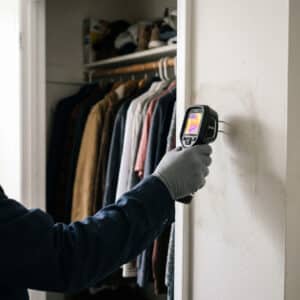
If you’re wondering how to get mold out of carpet in your Houston home, the answer depends on how far it has spread. A small surface patch from a spilled drink is something most homeowners can handle in an afternoon. Mold that soaked into the padding, or covers more than 25 contiguous square feet, is a different problem. Texas law treats it differently, too, and that part matters more than most online guides admit.
Houston’s Gulf Coast humidity gives carpet mold a head start. Indoor humidity above 60% combined with year-round AC condensation means a wet carpet here can develop visible mold in 24 hours. That’s why catching it early is the difference between a vinegar-and-elbow-grease afternoon and a four-figure remediation bill.
Mold Testing Houston has been the city’s independent mold assessment company since 2017. We carry TDLR license ACO1245, and Texas law prohibits us from performing remediation, which means our reports tell you what’s actually going on instead of what would make us money. This guide walks through what you can do yourself, what we’d handle, and where the line legally sits.
Why Does Mold Grow in Carpet?
Mold grows in carpet because carpet traps moisture in fibers and padding where air can’t reach. Once moisture stays in place for 24 hours, mold spores already in the air settle and start to colonize. In Houston, the moisture source is rarely a single dramatic event. It’s usually a slow AC condensation leak, a hurricane-season roof drip that travels along a ceiling joist, or a slab leak from beneath the foundation.
The five most common Houston carpet mold sources we see in homes:
- AC condensation lines that overflow and saturate carpet near closets or utility rooms
- Slab leaks under homes on Houston’s clay soil that wick moisture up through carpet padding
- Roof leaks from hurricane and tropical-storm damage that travels before showing up as a visible ceiling stain
- Bathroom and kitchen plumbing leaks behind walls
- Flooding events from Harvey, Imelda, Beryl, and the smaller storms that don’t make national news
The pattern in every case is the same: moisture gets in, doesn’t dry within 24 hours, and mold takes hold.
How Do You Know If There’s Mold in Your Carpet?
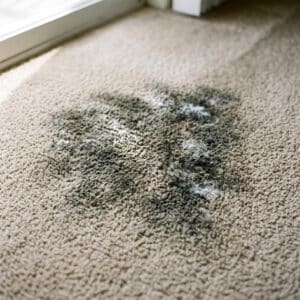
You’ll usually smell mold in carpet before you see it. A persistent musty or earthy odor in a room is the most reliable early sign, especially if the smell intensifies in humid weather or after running the AC. Other indicators:
- Visible green, black, or white spotting on the carpet surface
- Discoloration that doesn’t lift with regular cleaning
- Unexplained allergy or respiratory symptoms (congestion, coughing, headaches) that improve when you leave the room
- Carpet that feels damp or cool to the touch in spots
- A history of past water damage to the room, even if it dried “completely.”
If you suspect mold but can’t find it, the issue is usually under the carpet rather than on top. Pull back a corner and check the padding. Padding that looks discolored, feels damp, or smells musty is already compromised, regardless of what the carpet surface shows.
How to Get Mold Out of Carpet: 6 Steps That Work
This process works for surface mold on a contained patch smaller than 25 square feet (a 5-by-5 area) where the padding has not been affected. If your situation is larger or deeper, skip to the next section.
Step 1: Confirm the Mold Is on the Surface
Lift a corner of the carpet and look at the padding underneath. If the padding is dry and clean, the mold is on the surface, and you can continue. If the padding is wet, discolored, or smells musty, stop here. Surface cleaning won’t fix it, and continuing to scrub will release more spores into the air. Call a licensed Houston mold inspector at this point.
Step 2: Put On Protective Gear
Wear nitrile gloves, an N95 respirator (not a cloth or surgical mask), and safety goggles. Mold spores cause allergic reactions and respiratory symptoms even in people without prior sensitivities. The cleaning process itself releases more spores into the air than the mold was releasing while undisturbed.
Step 3: Ventilate and Contain the Room
Open exterior windows on opposite sides of the room to create cross-ventilation. Close interior doors to other parts of the house. Run a fan blowing outward through a window, not inward, so spores leave the home rather than spreading. Turn off the central AC during cleaning so it doesn’t pull spores through the ductwork and deposit them in other rooms.
Step 4: HEPA-Vacuum the Area
Use a vacuum with a true HEPA filter. A standard household vacuum will redistribute mold spores into the air through its exhaust and make the problem worse. Vacuum slowly over the affected area and 12 inches beyond it in every direction, then immediately empty the canister into a sealed plastic bag and take it outside.
Step 5: Apply White Vinegar and Let It Sit
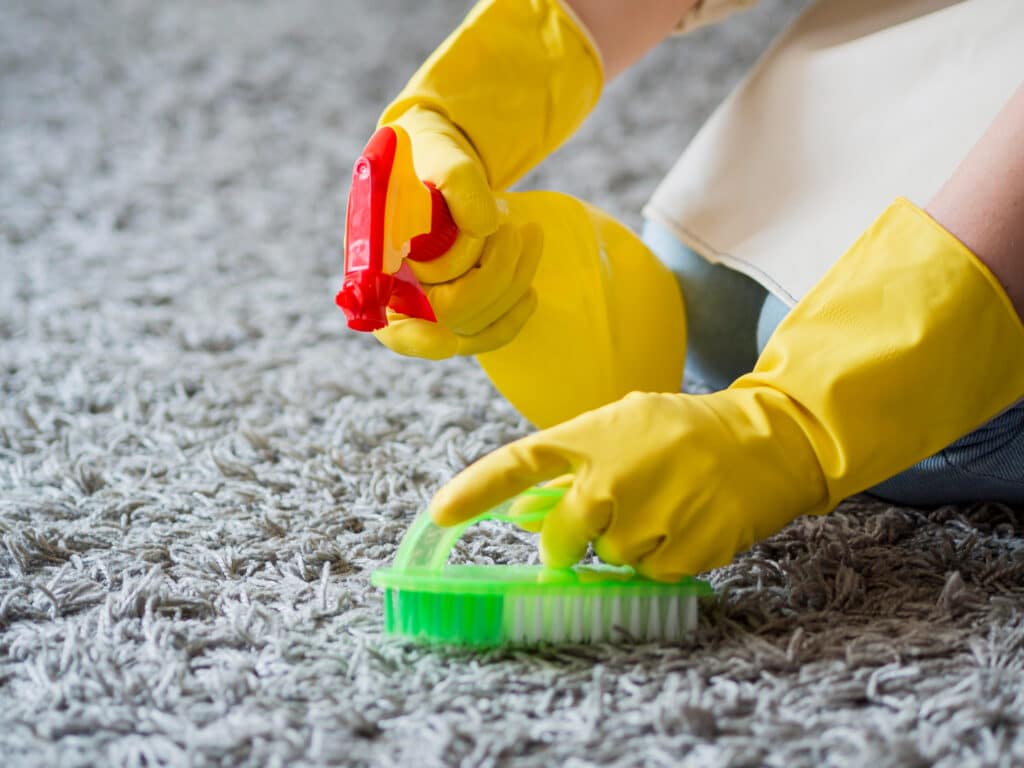
Spray undiluted distilled white vinegar directly onto the moldy patch until the area is saturated but not soaking. Let it sit for one hour. Vinegar’s acetic acid kills most common household mold species at the surface level. Skip bleach. Bleach doesn’t penetrate porous materials like carpet fibers, and the EPA’s mold cleanup guidance specifically advises against it for porous surfaces.
After the vinegar sits, scrub gently with a stiff-bristle brush in circular motions. Blot up the moisture with clean cotton towels, then dispose of the towels in a sealed plastic bag.
Step 6: Dry the Area Completely Within 24 Hours
Drying is the step most homeowners get wrong, and it’s the step that determines whether mold comes back. Place a box fan or air mover directly on the cleaned area and run it for at least 24 hours. Use a dehumidifier in the room to keep humidity below 50% during drying. Houston’s ambient humidity will fight you here, especially during hurricane season, which is why a dehumidifier matters more here than in dry climates.
Once dry, run the HEPA vacuum over the area one more time to capture any spores released during drying.
When DIY Stops Working: The 25-Square-Foot Rule
This is the part most online mold guides skip, and it matters more than the cleaning steps above.
In Texas, mold remediation on areas of 25 contiguous square feet or larger must be performed by a licensed mold remediation contractor. This is regulated by the Texas Department of Licensing and Regulation (TDLR) under the Texas Mold Assessment and Remediation Rules. A homeowner is not legally permitted to clean a mold patch larger than that themselves, and a general handyman or carpet cleaner without TDLR licensing is not permitted to do it on their behalf.
The rule exists because mold problems at that scale almost always involve hidden contamination that homeowners can’t see. By the time visible carpet mold covers a 5-by-5 area, the underlying padding and often the subfloor are usually compromised too. Cleaning the surface gives a false sense of resolution while the actual problem continues to grow underneath.
Texas law also separates the roles of assessment and remediation. A licensed mold assessor (like Mold Testing Houston, ACO1245) inspects, tests, and writes the remediation protocol. A separate licensed contractor performs the cleanup. The assessor cannot also be the remediator. This is why MTH never quotes you on removal work: we’re not legally allowed to, and the separation protects you from a conflict of interest where the company finding the mold is the same one charging to remove it.
How Do You Get Black Mold Out of Carpet?
You don’t, in most cases. Black mold (the common name usually refers to Stachybotrys chartarum) requires moisture to be present for at least seven to ten days to develop, which means by the time you see it, the carpet padding and possibly the subfloor underneath have been wet for a week or more. At that point, the porous materials below the carpet are colonized, and surface cleaning won’t reach them.
The honest answer for visible black mold in carpet is that the carpet, the padding, and a portion of the subfloor likely need to be removed and replaced. Before any of that happens, you want a TDLR-licensed assessor to test the air, identify the species, locate the moisture source, and write a remediation protocol. That protocol is what protects you legally if you’re a tenant, and what’s required by most insurance policies before they’ll cover the work.
If you’re in the Houston area and you’re seeing what looks like black mold in your carpet, call us at 832-838-9387 for an independent inspection. Our mold inspections are $550, and the report stays the same whether you eventually pay $200 to throw out a small patch of carpet or $20,000 to remediate a whole-room contamination. We don’t perform remediation, so there’s no upsell.
Can Moldy Carpet Be Saved?
Sometimes, but the honest answer is less often than most carpet-cleaning company guides suggest.
You can save the carpet when all of the following are true:
- The mold is on the surface only
- The patch is smaller than 25 contiguous square feet
- The padding underneath is clean and dry
- The subfloor underneath is dry
- The moisture source has been identified and fixed
- The carpet dries completely within 24 hours of cleaning
If any of those conditions aren’t met, replacement is usually the more cost-effective path. Carpet, padding, and labor in the Houston market run roughly $4 to $8 per square foot installed for mid-grade residential carpet. Remediation of a heavily contaminated room frequently exceeds the replacement cost, particularly when subfloor work is involved.
This is one of the questions our inspections answer directly. The protocol we write specifies exactly what gets cleaned, what gets removed, and what gets replaced, so you’re not making the call based on a contractor’s estimate.
How Do You Prevent Mold in Carpet?
Prevention in Houston comes down to managing moisture in a climate that fights you on it.
- Keep indoor humidity below 50%. A whole-home dehumidifier or a standalone unit in carpeted areas pays for itself in avoided mold remediation. Houston’s ambient humidity makes this harder than in most U.S. cities.
- Clean spills immediately, then dry within 24 hours. Mold develops faster here than the standard window most national guides cite, because of ambient humidity.
- Run AC year-round with regular maintenance. Houston has roughly nine months of cooling season. AC condensation lines and drain pans need annual inspection. A clogged condensation line dumping into a wall cavity is one of the most common hidden mold sources we test.
- Install mold-resistant carpet padding if you’re replacing carpet anyway. Closed-cell or synthetic-fiber padding handles moisture better than felt or rebond.
- Test annually if your home flooded during Harvey, Imelda, Beryl, or any other named storm. Post-flood mold can take 18 to 24 months to surface, well after the visible damage seemed handled.
Frequently Asked Questions
Does vinegar kill mold in carpet?
Yes, distilled white vinegar kills most common household mold species on contact at the carpet surface level. Spray it undiluted, let it sit for one hour, then scrub gently. It won’t reach mold that has penetrated into the carpet padding or backing, so vinegar is a surface-level fix only.
How long does it take for mold to grow in wet carpet?
Mold can develop in wet carpet within 24 hours in Houston’s climate. National guides often cite a longer window, but high ambient humidity and warm indoor temperatures shorten it here. Drying a wet carpet within 24 hours is the single most reliable way to prevent mold from forming.
When should I replace moldy carpet instead of cleaning it?
Replace moldy carpet when the padding is also affected, when the patch is larger than 25 square feet, when black mold is visible, or when the mold returns after a thorough cleaning. Replacement is also more cost-effective than remediation in most cases where the subfloor is involved.
Is mold in carpet dangerous to breathe?
Mold spores in carpet can trigger allergic reactions, asthma flare-ups, and respiratory symptoms, especially in children, elderly residents, and people with compromised immune systems. If anyone in the home has unexplained respiratory symptoms that improve when leaving the house, mold is one of the conditions worth ruling out. If you suspect health symptoms related to mold exposure, consult a medical professional.
Do I need a licensed inspector for carpet mold in Texas?
In Texas you need a TDLR-licensed mold assessor (not a remediator) any time mold contamination covers 25 contiguous square feet or more, when mold is suspected behind walls or under flooring, or when documentation is needed for insurance, real estate disclosure, or a landlord dispute. For small surface patches under 25 square feet with no padding involvement, you can handle it yourself.
How much does a Houston mold inspection cost?
A standard mold inspection from Mold Testing Houston is $550 and includes a full visual inspection, air or surface sampling depending on the situation, lab analysis, and a written report within 24 hours. If a remediation protocol is needed, that’s an additional $750 flat fee and includes the full assessment plus the protocol document.
Suspect Mold in Your Houston Home?
Independent inspection from a TDLR-licensed Houston assessor (ACO1245). $550 flat fee. Report in 24 hours. We don’t perform remediation, so the report you get is honest.