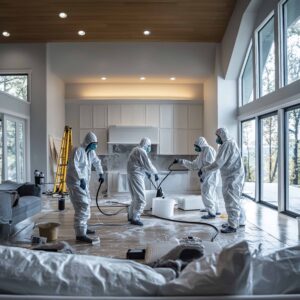
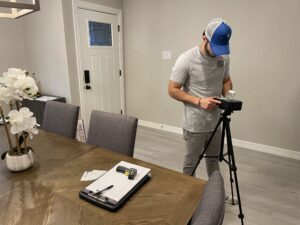
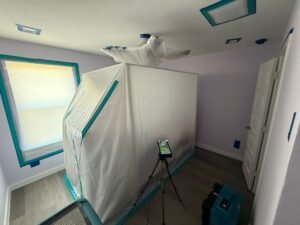
Testing for mold means one of two things. A surface sample (swab or tape lift) tells you what a visible spot is. An air sample (spore trap) measures what you are actually breathing, compared against an outdoor control taken the same day. The outdoor control is the part that matters: without it, a spore count is a number with nothing to compare it to. DIY kits skip that step, which is why they say yes almost everywhere. Our inspection is a flat $550 and results come back in one business day.
Most people searching how to test for mold have already noticed something: a musty smell that will not leave, a stain spreading under a window, symptoms that ease when they go away for a weekend. The instinct is to find out whether there is mold. That instinct is close, but it points at the wrong question.
Mold spores are in the air of every building on earth. A test that tells you mold is present tells you almost nothing. The useful question is whether the spore level inside your home is elevated against what is normal outside on the same day, and where the moisture feeding it is coming from. That is what a real test measures, and it is the part a hardware store kit cannot do.
Mold Testing Houston has provided independent mold testing in Houston since 2017 under TDLR license ACO1245. We assess, and we never remediate, so this guide has no cleanup to sell you at the end of it.
The Two Tests, and What Each One Actually Answers
Nearly every mold test is one of these two, or both together. They answer different questions, and choosing the wrong one is the most common way people waste money.
| Method | What it answers | What it cannot tell you |
|---|---|---|
| Air sample (spore trap) | Airborne spore concentration indoors, measured against an outdoor control taken the same day | Exactly which wall cavity the spores came from |
| Surface sample (swab or tape lift) | Whether a specific visible spot is mold, and which genus it is | Whether spores are circulating anywhere else in the home |
| Bulk sample | How deeply mold has penetrated a material (drywall, insulation, carpet) | Anything about the air you are breathing |
A proper assessment usually runs air and surface together, plus a moisture survey, because the pairing is what makes any of the numbers meaningful. If you want the full comparison, we break down air sampling versus surface sampling and when each is the right call.
Why a DIY Kit Almost Always Says Yes
DIY kits are not a scam, exactly. They are just answering a question that has a known answer. Here is what each type of consumer mold product actually measures.
- Petri dish settle plates. You leave a dish open, spores land on it, something grows. Because mold spores are in the air everywhere, a settle plate will culture something in any house on earth. A colony is not a finding. This is the single biggest source of false alarms in mold testing.
- Humidity monitors. These measure a risk condition, not mold. A high reading does not mean mold exists. A normal reading does not mean it is absent.
- Consumer air-quality monitors. They track particulates, sometimes VOCs. They cannot distinguish a mold spore from ordinary dust, so they cannot confirm a mold problem.
- Moisture meters. Genuinely useful, and professionals carry them. But reading one correctly, and knowing where to point it, takes training. The meter is not the skill.
The deeper problem with a DIY kit is not the equipment. It is the three things it structurally cannot do:
- No outdoor control. Without a baseline sample taken outside on the same day, an indoor spore count has nothing to be measured against. Houston’s outdoor spore load swings hard after rain, so an indoor number without its control is close to meaningless.
- No moisture diagnosis. The kit cannot tell you where the water is, and the water is what determines what the repair costs. A spore count without a moisture source is trivia.
- No acceptance. No insurer, lender, remediation contractor, or landlord will act on a hardware store result. If your reason for testing is documentation, a kit cannot produce it.
Where a kit is fine: idle curiosity. Where it is not: anything where the answer changes what you do.
When You Do Not Need a Test at All
This is the part most mold companies will not tell you, and it comes from the regulator, not from us. The U.S. Environmental Protection Agency notes that when visible mold growth is already present, sampling is often unnecessary to confirm you have a problem. If you can plainly see it, a lab does not need to tell you it is there.
What you still need in that situation is to find the water feeding it, and to know how far it has spread. Those are the two things a swab cannot answer and a moisture survey can.
So the honest rule is this. Test when the answer changes what you do: no visible growth but a persistent smell or symptoms, a real estate transaction, an insurance claim, a landlord dispute, or verification that a remediation actually worked. Skip the test when you can see the mold, you know where the leak is, and the patch is small enough to clean yourself.
How a Professional Mold Test Actually Works
Four steps, in this order. The order matters, because each one narrows what the next one has to look for.
- Visual inspection. Walls, ceilings, floors, attic, HVAC system, under cabinets, around windows. The inspector is looking for visible growth, water staining, and the conditions that let mold start. In Houston this means the attic air handler and the plumbing wall get looked at early, because that is where the water usually is. Our guide to attic mold in Houston homes covers why.
- Moisture and humidity survey. Calibrated moisture meters and a thermal imaging camera measure relative humidity, surface moisture, and dew point, and find water inside wall cavities and under floors without opening anything up. This is the step that finds the actual problem. Everything after it is confirmation.
- Air and surface sampling. Air samples measure airborne spore counts. Surface swabs or tape lifts confirm the species on any visible growth. Every indoor air sample is paired with an outdoor control taken the same day, in the same weather.
- Lab analysis and written report. Samples go to an accredited laboratory for species identification and spore counts. You get a written report comparing your indoor levels to the outdoor baseline, with the affected locations and specific recommendations.
The on-site visit runs one to two hours for a typical home. Lab results come back in one business day, so a Friday inspection means results on Monday. Same-day appointments are often available.
How to Read the Results
Mold test results confuse people because they arrive as numbers with no obvious scale. Here is the scale.
There is no federal standard for a safe mold level. The EPA is explicit about this: no federal standards exist for acceptable airborne mold concentrations. Anyone quoting you a universal “safe number” is making it up.
Because there is no absolute threshold, the only comparison that means anything is indoor versus outdoor, same day. If your indoor spore count is meaningfully higher than the outdoor control, or if the species profile indoors is different from what is outside, you have an indoor source. If indoor and outdoor track together, the air in your home reflects the air in your neighborhood, and that is a normal result.
Three more things worth understanding:
- Species matters, but color does not. The lab identifies genus and species. What you see on a wall cannot. Our guide to the types of mold found in Houston homes explains what color can and cannot tell you.
- The recommendations usually matter more than the numbers. The count tells you there is a problem. The moisture finding tells you what to fix.
- Above 25 contiguous square feet, Texas takes over. At that threshold, state law requires a licensed remediation contractor working from a written mold remediation protocol prepared by a licensed assessor. That protocol also sets the criteria your clearance testing will later be judged against.
What Mold Testing Costs in Houston
Our inspection is a flat $550. That covers the visual assessment, the moisture and thermal survey, air and surface sample collection, accredited lab analysis, and the written report. There is no upsell path, because there is nothing to upsell you to. A remediation protocol, if the lab confirms you need one, starts at $750.
Prices in the Houston market vary widely, and the spread usually comes down to whether there is any lab work behind the number. A very cheap inspection is often a visual-only walk-through with no samples, which produces no documentation anyone will accept. Our full breakdown of mold testing cost in Houston covers what actually drives the price.
And if you are being offered a free mold inspection in Houston, it is worth understanding who pays for it and why.
Who Should Do the Testing
In Texas, mold assessment and mold remediation on the same project must be performed by separate companies. The state wrote that separation into law for an obvious reason: the company that gets paid to remove mold should not be the company deciding how much mold you have.
Mold Testing Houston is licensed to assess, not to remediate. We hold TDLR Mold Assessment Company license ACO1245, and we have never offered remediation services. When our report says your air is clean, there is no cleanup contract we just lost. When it says you have a problem, there is no cleanup contract we just won. That structure is the entire reason to be careful about who conducts your mold inspection, and it is why a licensed mold inspection in Houston is worth more than a free one.
Frequently Asked Questions
How long does it take to get mold test results?
At Mold Testing Houston, lab results come back in one business day. A Friday inspection means results on Monday. Turnaround varies by company and by laboratory, and some take considerably longer, which matters when a real estate option period or an insurance deadline is running.
Do DIY mold test kits work?
Not reliably. Because mold spores are present in all indoor air, a petri dish kit will grow something in nearly any home, which produces false alarms. A kit sitting in one room can also completely miss mold growing inside a wall or an HVAC system a few feet away. And with no outdoor control sample, the result has no benchmark to be measured against.
Do I need to leave my home during mold testing?
No. An inspection is non-invasive and you can stay in the house. Remediation is different, and if contamination is significant, a licensed remediation contractor may recommend temporary relocation while the work is done.
Can mold be completely eliminated from a home?
No, and any company promising that is selling something. Mold spores exist in all air, indoors and out. The goal is not zero spores. The goal is removing the growth, fixing the moisture that fed it, and returning indoor spore levels to a normal range relative to outdoors.
How often should I test for mold?
There is no routine schedule. Test when something prompts it: a water event, a musty odor you cannot trace, symptoms that improve when you leave the house, a real estate transaction, or verification after a remediation. If you rent, the process for testing mold in a Houston apartment has some extra documentation steps worth knowing.
What are the signs I should test for mold?
A persistent musty smell, visible staining or discoloration, bubbling paint or warped drywall, a musty odor that arrives when the AC starts, or symptoms that track with time spent in the house. We cover the full list in our guide to the signs of mold in a Houston home.
If you want a definitive answer about what is actually in your air, you can book an inspection online or call us at 832-838-9387.