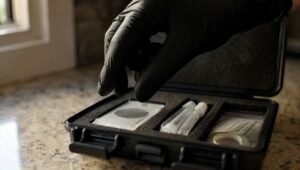
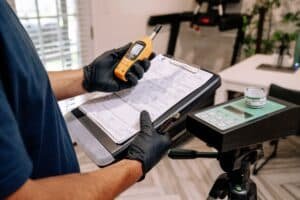
Mold testing cost in Houston is one of the most confusing parts of dealing with a suspected mold problem. National sites quote anything from $200 to $1,000. Local companies often hide their pricing behind contact forms. Free inspections are common but rarely free in any useful sense. This guide breaks down what mold testing actually costs in Houston, what should be included in that price, and what the pricing model tells you about the inspector you are hiring.
It also covers the question most cost guides skip: what to do when two contractors quote the same house and the numbers are nowhere near each other.
What Is the Real Range for Mold Testing Cost in Houston?
A standard residential mold inspection in Houston costs between $300 and $600, and that consensus holds across most published cost guides for the market. The wide spread inside that range reflects huge variation in what different companies actually include in the quoted price, and jobs outside the standard tier move outside the range entirely.
A useful way to think about Houston mold testing pricing is to break it into three tiers:
- Visual-only inspection ($200 to $350). A licensed inspector walks the home, looks for visible mold, and takes moisture readings. No lab samples. This is appropriate when there is no visible suspect mold and the homeowner just wants a professional eye on the home.
- Standard residential inspection with sampling ($300 to $600). Visual inspection plus moisture mapping, thermal imaging, and lab-analyzed samples with accredited analysis and a written report. This is what most Houston homeowners actually need.
- Complex or large-home inspection ($700 to $1,200+). Larger homes, commercial properties, multi-room contamination, or inspections that require many sampling points fall here.
Mold Testing Houston operates a flat-rate $550 standard residential inspection that lands in the middle tier, covering homes up to 2,500 square feet. The flat rate is deliberate. It removes the conflict of interest where an inspector might recommend more samples than the situation calls for in order to inflate the bill.
The other thing the flat rate removes is geography math: the mold inspection cost in Katy, mold inspection cost in Sugar Land, and mold inspection cost in Memorial are all the same $550 as inside the Loop.
How Much Does a Mold Inspection Cost in Houston?
A mold inspection in Houston costs $300 to $600 for a standard residential job with lab-analyzed samples. Mold Testing Houston charges a flat $550 for homes up to 2,500 square feet, with everything included. Here is how that compares to what else is on offer in this market:
| What you are buying | Typical Houston price | Mold Testing Houston |
|---|---|---|
| Standard residential inspection with sampling | $300 to $600 | $550 flat, up to 2,500 sq ft |
| Each lab-analyzed sample | $50 to $100 each, often added after the quote | Two included, $85 each after that, only with your approval |
| Written report with lab results | Sometimes extra, 3 to 5 business days | Included, one business day |
| Rush or expedited results | $100 to $250 surcharge | No rush tier, because one business day is the standard |
| Mold remediation protocol | $500 to $1,200 | Starts at $750 |
The number that surprises people is not the base price. It is what happens after it. A “from $300” inspection that adds four samples at $75 each lands at $600 before the report is written, which is why the flat fee exists.
Testing Cost vs Remediation Cost: Two Different Numbers
Most people searching for mold costs are holding two questions at once, and mixing them up leads to bad decisions.
Testing is what an independent licensed assessor charges to find out what you have. In Houston that is a few hundred dollars, and it is the number this guide covers.
Remediation is what a licensed contractor charges to remove it, and it is a different order of magnitude. Remediation quotes for the same house routinely differ by three times or more, because contractors are pricing scope decisions rather than measuring a fixed quantity: where contamination stops, whether materials get removed or cleaned in place, how many zones get contained, and whether the HVAC system and the moisture repair are inside the number. We break that down in detail in our guide to whether a Houston mold remediation quote is fair.
The useful move when two quotes diverge is not a fourth quote. It is a written scope both contractors have to bid against. In Texas that document has a name and a legal requirement behind it: once contamination reaches 25 contiguous square feet, a licensed Mold Assessment Consultant has to write a mold remediation protocol, and the remediator works from it.
Is Mold Testing Worth the Cost?
Mold testing is worth the cost when the result has to carry weight: a real estate transaction, an insurance claim, unexplained health symptoms, or a suspected hidden problem behind walls or in ductwork. In those situations, a $300 to $600 test is cheap relative to what it protects. A buyer who tests before closing spends a few hundred dollars to avoid inheriting a five-figure remediation. A homeowner filing a water damage claim needs lab-verified documentation, because carriers do not pay on a contractor’s verbal opinion. Our guide on whether a mold inspection is worth it covers the cases where it is not.
Testing is not worth the cost in two situations, and an honest assessor will say so. First, if you can already see substantial mold and you know the moisture source, testing mostly confirms what you know, and the money is better spent on an assessment that scopes the fix. Second, routine testing of a symptom-free home with no water history rarely tells you anything actionable, since every home contains some mold spores. The value of the test is in answering a real question, not in producing a number for its own sake.
What Is Included in a $550 Mold Inspection?
The $550 flat rate covers the full inspection end to end for homes up to 2,500 square feet. There are no hidden lab fees and no add-on charge for the written report. Specifically, $550 covers:
- Full visual inspection of the interior, including accessible attic and crawl space areas where reasonable.
- Moisture mapping using calibrated moisture meters on suspect walls, floors, and ceilings.
- Thermal imaging to identify hidden moisture and temperature anomalies behind walls and under flooring.
- Up to two lab-analyzed samples, typically air sampling with the required outdoor control, plus surface sampling on visible growth.
- Accredited lab analysis by EMSL Analytical, an AIHA-LAP accredited third-party laboratory.
- Written inspection report with photos, lab results, findings, and clear next-step recommendations, delivered within one business day.
Additional samples beyond the first two are $85 each, and we collect them only with your approval, so you always know the number before it changes. Properties over 2,500 square feet are quoted individually. Call 832-838-9387 with the square footage, and you get a number before anyone is scheduled.
If you want to understand which sampling methods get used during the inspection, our guide on air sampling versus surface sampling walks through the decision logic.
What Costs Extra Beyond the Standard Inspection?
- Mold remediation protocol (starts at $750). When a remediation project is required, Texas law requires a licensed Mold Assessment Consultant to write a formal protocol before any work begins. That document specifies the scope, methods, containment, and the clearance criteria the contractor has to meet. See what a Houston remediation protocol has to include for the full breakdown.
- Post-remediation clearance testing. After remediation is complete, a separate clearance inspection confirms the work meets the protocol’s criteria. Separate visit, separate invoice. Texas requires it for any project needing a Certificate of Mold Damage Remediation.
- Additional samples. $85 each beyond the first two, always with your approval first.
- Larger or commercial properties. Quoted individually based on square footage and the number of sampling points needed. Our guide to commercial mold inspection in Houston covers what property managers need documented.
- Rush turnaround. There is no rush fee, because there is no rush tier. Some Houston companies charge extra to expedite lab results. Our standard turnaround is one business day, so there is nothing to expedite. A Friday inspection means results on Monday.
Why Are Houston Mold Inspection Prices So Different Between Companies?
Licensing and Insurance Overhead
Texas law requires any company performing mold assessment to hold a TDLR Mold Assessment Company license, which requires at least one licensed Mold Assessment Consultant on staff. That consultant must complete a 40-hour TDLR-accredited training course, pass a state exam, and maintain a minimum of $1 million in commercial general liability insurance. The TDLR mold laws and rules set the entire regulatory floor for what licensed work involves. Those costs make legitimate licensed mold assessment more expensive than an unlicensed handyman or a mold consultant with no credentials. If you are not sure how to tell the difference, our guide on how to find a mold inspector in Houston covers how to verify a license. Ours is ACO1245, and we would rather you look it up than take our word for it.
Equipment and Lab Costs
Calibrated moisture meters, thermal imaging cameras, calibrated air sampling pumps, spore trap cassettes, and accredited lab fees all factor into the cost. A licensed inspector using AIHA-accredited lab analysis has a higher cost floor than someone using cheaper, less reliable analysis methods.
Conflict of Interest
Companies that offer free mold inspections typically generate revenue from remediation work. They are looking for mold to clean up. An independent assessment company, by contrast, charges for the inspection because the inspection is the product. Texas rules prohibit the same license holder from performing both mold assessment and mold remediation on the same project, which is the legal expression of this conflict-of-interest principle.
Per-Sample Pricing vs Flat Rate
Some Houston inspectors quote a low base price like “from $300” and then add $50 to $70 per sample. A standard inspection requiring four samples plus an outdoor control suddenly costs $300 plus five samples at $70, which is $650. The “from” price was always misleading. Flat-rate pricing avoids this by including the necessary samples upfront and pricing anything beyond them openly.
What About Free Mold Inspections in Houston?
Most free mold inspections in Houston are offered by remediation companies looking for cleanup work. The inspection itself is genuinely free. The business model depends on selling remediation services afterward. The conflict of interest is built into the offer.
Free inspections fail several practical tests Houston homeowners care about:
- They typically skip air sampling and rely entirely on visual checks, which miss hidden mold
- The report rarely includes lab analysis or accredited documentation
- If the inspector recommends remediation, the conclusion has an obvious financial motive
- The report is generally not accepted as documentation for insurance claims, real estate disclosure, or legal disputes
Frequently Asked Questions
Will insurance pay for a mold test?
Sometimes. Standard Texas homeowners policies typically cover mold testing when it is ordered as part of investigating a covered water damage claim, such as a burst pipe, an appliance leak, or storm damage. Most policies do not cover proactive testing when there is no covered loss event. Most Texas carriers also tightened their mold endorsements after the litigation wave of the early 2000s, so many policies now cap mold coverage at a specific dollar figure regardless of actual cost. Call your carrier before scheduling if you plan to file, because they may require a specific process or vendor.
How much does mold testing cost in Houston per sample?
Houston inspectors who use per-sample pricing typically charge $50 to $100 per sample, sometimes higher for specialized analysis. A standard inspection requiring four samples plus an outdoor control could add $250 to $500 on top of the base fee. Our flat rate includes the first two samples, with any additional at $85 each and only with your approval, so the number never moves without you agreeing to it first.
What happens if my house tests positive for mold?
A positive result is a starting point, not a verdict, because every home contains some mold spores. What matters is whether indoor levels are elevated against the outdoor baseline and which species are present. If the results confirm a genuine problem under 25 contiguous square feet, cleanup can often be handled simply once the moisture source is fixed. If contamination is larger, Texas law requires a written remediation protocol from a licensed assessor before a licensed contractor begins work, and independent clearance testing afterward verifies the job actually succeeded. Either way, the report tells you the scale of the problem before anyone quotes you a cleanup price, which is exactly the order you want those two numbers to arrive in.
How much does a mold remediation protocol cost in Houston?
A mold remediation protocol from Mold Testing Houston starts at $750 and scales with the number of remediated areas. It is a separate deliverable from the inspection. Texas law requires a licensed Mold Assessment Consultant to write the protocol before any licensed remediation contractor can begin work, and the protocol sets the clearance criteria the contractor will later be measured against.
Why does a mold inspection cost more than a home inspection?
They are two different categories of work under Texas law. A general home inspector is licensed by TREC and has no authority to take mold samples for laboratory analysis. A mold assessment requires a TDLR-licensed assessor, accredited lab work, and a written assessment report. The training, licensing, insurance, and lab costs are different, which is why the pricing is different.
Are there cheaper alternatives if I am on a tight budget?
Not really, if you want defensible results. Visual-only inspections without sampling are cheaper but miss hidden problems. DIY kits run $30 to $80 and are not accepted as documentation by any insurer, lender, or court, and they rarely include the outdoor baseline that makes a result mean anything. The most cost-efficient path is usually a flat-rate inspection with proper sampling done once, rather than a cheaper inspection that has to be redone. Our guide to how to test for mold explains why a kit will nearly always say yes.
How long does the inspection take, and when do I get results?
The on-site visit takes one to two hours for a typical home. Your written report with lab results is delivered within one business day of sampling, so a Friday inspection means results on Monday. Same-day appointments are often available. Our guide on how long a mold inspection takes breaks down the visit step by step.
Questions about what removal itself costs, how remediation is priced, and whether a quote you are holding is reasonable are answered in our Houston mold remediation quote guide.
Get a Flat-Rate Mold Inspection in Houston
If you want a transparent flat-rate mold inspection in Houston with no surprise per-sample fees, no upsells, and no conflict of interest, we have served Houston since 2017 under TDLR Mold Assessment Company License ACO1245. We inspect and test only. We do not perform remediation, and that independence is what makes the report stand up in real estate, insurance, and legal contexts.
If you are holding two remediation quotes that do not match, that is exactly the situation an independent scope is built for. Book an inspection online, call 832-838-9387, or read more about independent mold testing in Houston.