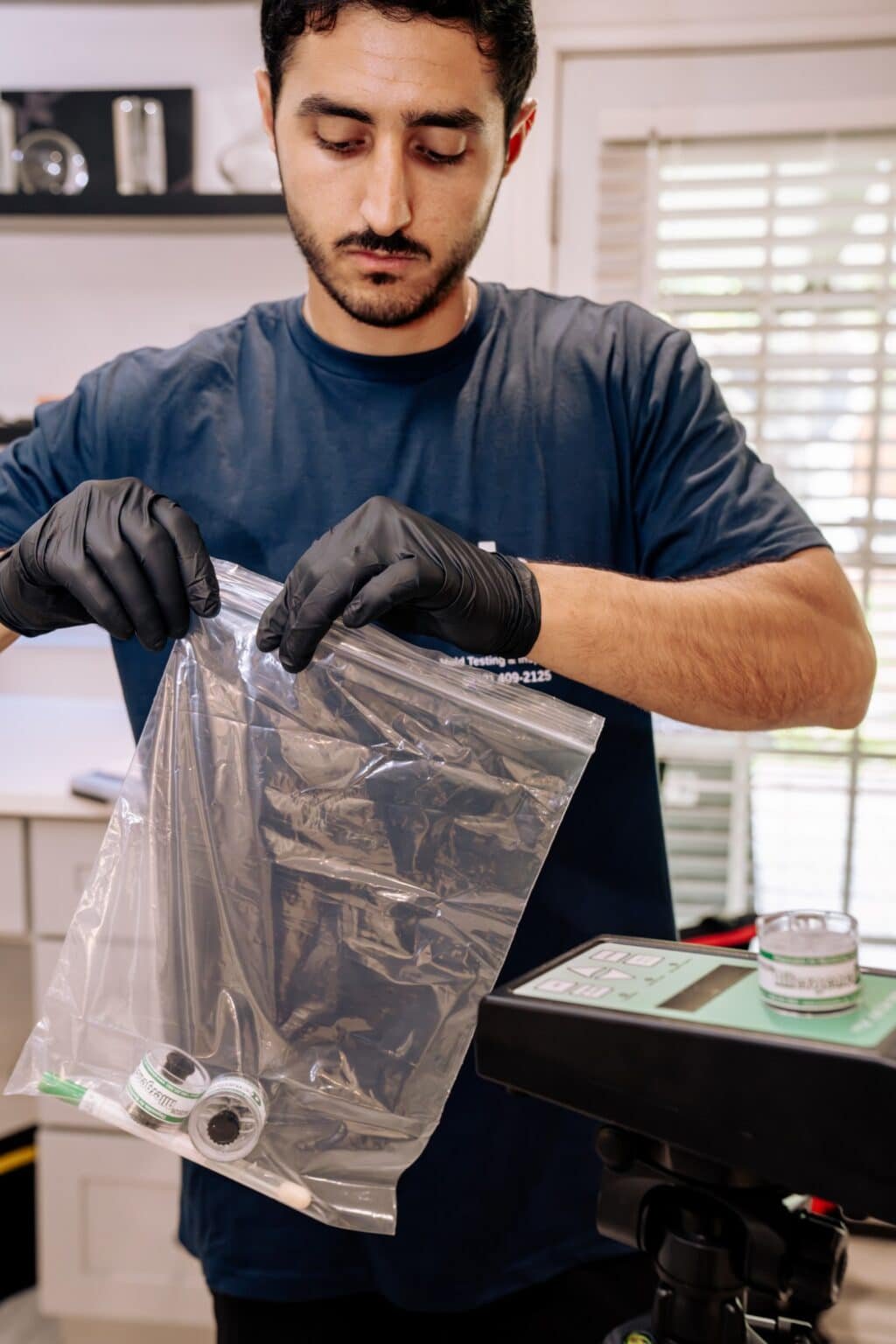
This is not the answer most mold companies give, because most mold companies sell testing.
Mold Testing Houston has been an assessment-only company since 2017, operating under TDLR license ACO1245. We do not perform remediation, so we have no cleanup work waiting behind a positive result. That also means we have no reason to talk you into a test you do not need, and there are a lot of homes that do not need one.
Here is how to tell which kind of home you have.
When You Do Not Need a Mold Test
Three situations where testing is usually a waste of money.
You can already see it and you know where the water came from. The U.S. Environmental Protection Agency is direct about this: when visible mold growth is present, sampling is generally unnecessary. A lab does not need to confirm what is in front of you, and the cleanup is largely the same regardless of which species it turns out to be. Fix the water, clean or remove the material, move on.
You want a routine annual check. There is no maintenance schedule for mold testing, and no benefit to one. Spores blow in from outdoors every time a door opens, so a test on a random Tuesday with nothing prompting it measures the weather more than it measures your house.
You are hoping for a pass or fail number. No federal standard exists for acceptable indoor mold levels. Not from EPA, not from anyone. A lab result is only meaningful as a comparison between your indoor air and an outdoor control sample taken at the same property on the same day. Any company quoting you a universal safe number is inventing it.
If all three of those describe your situation, close this page and go fix the leak. That advice costs you nothing and it is the right advice.
6 Times You Do Need a Mold Test
Now the exceptions. The first three are situations where you cannot see the answer. The last three are situations where you have to prove it to somebody who was not there.
1. You can smell it but you cannot find it
A musty odor with no visible source is the single most common legitimate reason to test. Something is growing where you cannot see it: inside a wall cavity, under flooring, behind a cabinet, or in the air handler. Air sampling with an outdoor control tells you whether indoor spore levels are actually elevated, and a moisture survey narrows down where the water is feeding it. Our guide to mold behind walls covers how an inspector confirms it without cutting into drywall.
Houston specific: if the smell arrives when the air conditioning kicks on and fades when it stops, look at the HVAC system first. That pattern points at the evaporator coil, the condensate line, or the return plenum.
2. There was water damage and you cannot see behind the wall
A burst supply line, a roof leak, a slab leak, or storm intrusion. The visible damage got dried and repaired, but nobody opened the wall to check what happened inside it. Mold does not need much time or much water, and drywall dries on the surface long before the framing behind it does.
Testing here answers a question demolition would otherwise have to answer, and it costs considerably less than exploratory demolition.
3. Someone feels better when they leave the house
If people in the household consistently feel better away from home and worse at home, that pattern is worth investigating even with nothing visible. Testing the air tells you what is actually in it, which is information a physician cannot get any other way.
Read the next section before you act on this one.
4. You are buying or selling a home
Buyers need documented findings from someone with no stake in whether the deal closes. Sellers benefit from the same thing in reverse: a clean lab-backed report takes a negotiating weapon off the table before anyone picks it up, and Texas requires sellers to disclose known mold and known water damage regardless. Our guide to a mold inspection before buying a Houston home covers option-period timing.
5. Remediation is finished and you need it verified
Post-remediation verification, also called clearance testing, confirms the work actually succeeded. A remediation contractor signing off on their own job is not verification, and in Texas the clearance has to come from a licensed assessor who is separate from the company that did the cleanup. More on clearance testing in Houston.
6. Someone else has to be convinced
An insurance adjuster, a landlord, a property manager, an attorney, or a lender. In all of these, the point of the test is not discovery, it is documentation. Nobody in that list will act on a verbal opinion or a hardware store result, and several of them have a financial reason to prefer your evidence be weak. If you rent, our guide to Texas mold landlord laws covers the written notice requirement that has to come first. Property managers fielding a tenant or employee complaint are in the same position, and commercial mold inspection in Houston covers what they need on paper.
We Test Buildings, Not People
Worth being clear about the line, because a lot of the internet is not.
A mold assessor is licensed to inspect structures. We can tell you what species are in your air, at what concentration, how that compares to outdoors, and where the moisture feeding it is coming from. That is a building measurement, and it is a real one.
What we cannot tell you is what any of it means for a specific person’s health. We do not diagnose, we do not interpret symptoms, and we do not recommend treatment. Any mold company publishing symptom checklists or detox protocols has stepped outside what its license covers.
If health is the reason you are asking, the useful sequence is straightforward. Get the air measured so you know what is actually there, then take that report to a physician who can put it together with everything else about the person. The test answers the building question. A doctor answers the human one.
What to Check Yourself First
Before you pay anyone, thirty minutes with a flashlight rules out a lot.
- Follow your nose. Musty smell is your most reliable instrument. Move through the house and find where it gets stronger.
- Check under every sink, plus around the water heater, the dishwasher, and the washing machine connection.
- Look at baseboards on exterior walls, at window sills, and anywhere a wall meets a floor near plumbing.
- Open the HVAC closet and look at the air handler, the drip pan, and the condensate line. In Houston this is the single highest-yield spot.
- Put your head in the attic. Look for dark staining on the decking and rust on nail points, which indicates condensation.
- Watch for the indirect signs: bubbling paint, warped flooring, drywall that feels soft, or a wall that is cooler to the touch than the ones beside it.
Our guide to the signs of mold in a Houston home covers each of these in more detail, including three things that fool people.
If that walkthrough finds visible growth and an obvious water source, you are in the first section of this page and you do not need us. If it finds nothing but the smell is still there, you are in reason one and you probably do.
If You Do Need a Test, What Kind?
Air sampling measures what you are breathing, compared against an outdoor control. Surface sampling identifies what a specific visible spot is. Most real assessments use both plus a moisture survey, because a spore count with no moisture finding tells you there is a problem without telling you what to fix.
We cover the trade-offs in detail in air sampling versus surface sampling.
Whichever you need, two things determine whether the result is worth anything: an outdoor control taken the same day, and an accredited lab. Ours go to EMSL Analytical, an AIHA-LAP accredited laboratory with no financial relationship to us. Results come back in one business day, so a Friday inspection means Monday results.
On price, our inspection is a flat $550 and a remediation protocol, if the lab confirms you need one, starts at $750. Market rates vary widely and the spread usually comes down to whether there is lab work behind the number, which our mold testing cost breakdown covers. If someone is offering to do it for free, our guide to free mold inspections in Houston explains who pays for that and how.
Frequently Asked Questions
What are signs you need mold testing?
A musty smell you cannot trace to a visible source, water damage that was repaired without anyone opening the wall, a musty odor that arrives when the air conditioning starts, or a situation where someone other than you needs proof. Visible growth with a known water source is not a sign you need testing. It is a sign you need a repair.
Is mold testing necessary if I can already see the mold?
Usually not. The EPA’s position is that sampling is generally unnecessary when growth is visible, and the cleanup approach does not change much based on species. Testing still makes sense in that situation if you need documentation for an insurance claim, a landlord, or a real estate transaction, or if you need to know how far the contamination extends beyond what is visible.
How can I check for mold in my house myself?
Walk the house with a flashlight and follow the musty smell to wherever it strengthens. Check under sinks, around the water heater and appliances, along baseboards on exterior walls, at window sills, in the HVAC closet, and in the attic. Look for staining, bubbling paint, warped flooring, and rusty nail points on attic decking. What you cannot do yourself is measure spore concentration, identify species, or find water inside a wall cavity.
How can you tell if there is mold behind drywall?
Indirect signs first: a musty smell with no visible source, discoloration or staining bleeding through paint, bubbling or peeling paint, drywall that feels soft or spongy, or a section of wall noticeably cooler to the touch than the wall beside it. Confirming it takes either a moisture meter and thermal imaging to find the water, or a small borescope hole to look inside the cavity. A wall-cavity air sample can also be pulled directly from inside the wall.
Do air purifiers help with mold?
A HEPA purifier will capture spores already circulating in the room, which can reduce what you are breathing. It does nothing about the growth producing them or the moisture feeding it. Running a purifier while a leak continues is treating the smoke and ignoring the fire. Useful alongside a repair, not instead of one.
What takes mold spores out of the air?
HEPA filtration removes spores mechanically, and it is what remediation contractors use for exactly that reason. Ventilation helps by exchanging indoor air with outdoor air. Keeping relative humidity below 50 percent is what stops new spores from being produced. None of the three addresses growth already established on a surface or inside a wall, which has to be physically removed.
How do you get rid of mold 100 percent?
You do not, and any company promising it is selling something. Mold spores exist in all air, indoors and outdoors, and a spore-free building is not a thing that exists. The realistic goal is removing the growth, correcting the moisture that fed it, and returning indoor spore levels to a normal range relative to outdoors. Above 25 contiguous square feet, Texas requires a licensed remediation contractor working from a written remediation protocol prepared by a separate licensed assessor.
Still Not Sure Which Group You Are In?
Call and describe what you are seeing. If it sounds like a repair rather than a test, we will tell you that, and it costs you nothing. We are an assessment-only company under TDLR license ACO1245, we do not perform remediation, and we have no cleanup contract riding on the answer.
If you do need a test, a flat $550 inspection covers the visual assessment, the moisture and thermal survey, air and surface sampling, EMSL lab analysis, and a written report in one business day. Same-day appointments are often available across Houston and the surrounding metro.
Book an inspection online or call 832-838-9387.