An indoor air quality test in Houston usually starts with a smell, not a stain: a musty odor nobody can trace, a leak that was never checked, or a home monitor flashing red on a humid afternoon. Houston averages around 75% relative humidity year-round, while the EPA recommends keeping indoor humidity between 30 and 50%. When the air outside your home stays that damp for most of the year, the air inside is rarely far behind.
Mold Testing Houston has served the Greater Houston metro since 2017 as an assessment-only company. We hold TDLR Mold Assessment Company License ACO1245, and we do not perform remediation. That separation matters here, because it means when we report your spore levels, we have no financial reason to inflate them. We only test. This guide explains what an indoor air quality test actually covers, what it costs, what a home gadget can and cannot tell you, and how a licensed assessor reads your numbers.
“Indoor Air Quality Test” Can Mean Five Different Things
When Houston companies advertise indoor air quality testing, they are not all selling the same test. Before you book anything, it helps to know which question you are actually trying to answer:
- Mold spore testing. Lab-analyzed air samples that identify and count mold spores by species. This is what Mold Testing Houston does, and it is the right test for musty smells, hidden moisture, water damage history, and real estate transactions.
- VOC testing. Measures volatile organic compounds off-gassing from paints, adhesives, new furniture, and cleaning products. Points to chemical sources, not biological ones.
- Radon testing. A soil-gas test, usually run during real estate transactions. Unrelated to mold or humidity.
- Particulate monitoring. PM2.5 and PM10, which is what consumer monitors measure. Useful for tracking smoke, dust, and general air cleanliness over time.
- Combustion gas testing. Carbon monoxide and related gases, a safety check tied to appliances and ventilation.
We are a mold assessment company, so we run the first one. If your situation points to VOCs, radon, or combustion gases, you want an environmental testing firm or your utility rather than a mold assessor, and we will tell you that plainly if that is where your situation points. In Houston, though, the humidity math makes mold the most common reason people go looking for air testing, which is why this guide focuses there.
Can a Home Air Quality Monitor Detect Mold?
No. A home air quality monitor cannot detect mold in any meaningful way. The popular plug-in monitors sold online measure particulate matter, labeled PM2.5 and PM10, and sometimes volatile organic compounds. They count particles in the air, but they cannot tell a mold spore apart from ordinary dust, pollen, or cooking smoke.
Here is the core problem. Mold spores are microscopic, ranging from roughly 1 to 100 microns across. Some of the types we find most often in Houston homes, like Penicillium and Aspergillus, can be as small as 1 micron. That puts them in the same size range as soot. A particle monitor might show a spike on a humid day, but it has no way to know whether that spike is mold, dust, or the dinner you just cooked. The only way to identify and count mold spores is to capture a sample of air and examine it under a microscope in a lab.
So if you bought a monitor hoping it would warn you about mold, it will not. It is a useful tool for tracking general air cleanliness. It is not a mold test. Our guide to how to test for mold covers the other consumer products that fall into the same trap.
How Does an Indoor Air Quality Test for Mold Actually Work?
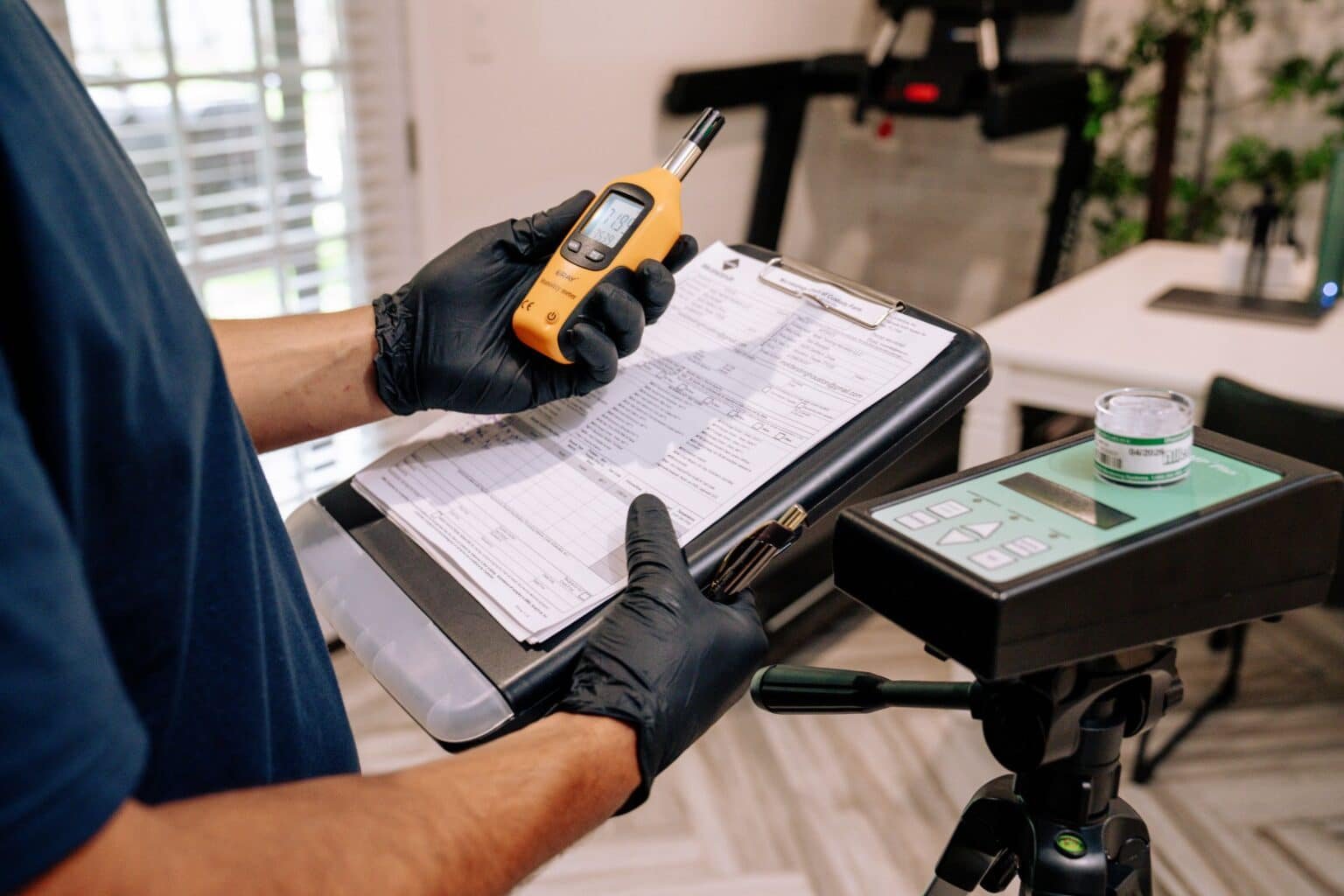
Professional air sampling works by drawing a known volume of air through a collection cassette, then analyzing what gets trapped. A calibrated pump pulls a measured amount of air, usually somewhere between 75 and 150 liters, through a small cassette containing a sticky slide. Airborne particles, including any mold spores, stick to that slide. The cassette goes to a laboratory, where an analyst examines it under a microscope at high magnification and counts the spores by type.
The part most people miss is the outdoor control sample. A good assessor always takes a sample from outside your home on the same visit. That outdoor reading sets the baseline for what is normal in your area on that specific day. Without it, the indoor number means very little. Air testing only makes sense as a comparison: indoor spore levels measured against the outdoor air around your home.
This is also where the difference between testing methods comes in. Air sampling finds spores floating in the air, including those coming from hidden sources. Surface sampling confirms what a specific stain or spot actually is. We cover when each one is the right call in our guide on air sampling versus surface sampling for mold.
What Does Air Quality Testing Cost in Houston?
Air quality testing for mold is part of a standard mold inspection, not a separate service. Ours is a flat $550 for homes up to 2,500 square feet, covering the visual and moisture inspection, calibrated air sampling with an outdoor control, analysis of up to two samples by EMSL Analytical, and a written report within one business day. Additional samples are $85 each and we collect them only with your approval. Properties over 2,500 square feet are quoted individually.
For what other Houston companies charge, how per-sample pricing changes the total, and why free air testing usually is not free, see our guide to mold inspection cost in Houston.
What Is a Normal or Safe Mold Spore Level?
There is no official safe level for mold spores in indoor air. This surprises a lot of homeowners, but it is the consistent position of every major authority. The U.S. Environmental Protection Agency states plainly that no federal limits or threshold values have been set for airborne mold or mold spores. The EPA’s guidance on mold testing and sampling confirms there is no number you can test against to prove a building is safe or unsafe, and adds that sampling should be conducted by professionals experienced in designing sampling protocols and interpreting results, following analytical methods recommended by organizations like the AIHA.
Because there is no fixed threshold, interpretation depends on three things working together: how your indoor count compares to the outdoor baseline, which species are present, and where the inspection found moisture. Some labs and consultants use rough reference points, such as treating counts under a few hundred spores per cubic meter as typical and counts over fifteen hundred as worth a closer look. Those are general industry reference points, not regulatory standards, and they only carry meaning when read against the outdoor sample and the specific mold types found.
The species matter as much as the number. A moderate count of one type can be far less concerning than a smaller count of a more aggressive one, which is why the lab identifies the types of mold found in Houston homes rather than just totaling them. It is also exactly why a raw number off a monitor would mislead you even if a monitor could produce one.
How Accurate Is an Indoor Air Quality Test for Mold?
An indoor air quality test for mold is accurate when it is done correctly, but the result is a snapshot, not a permanent score. Spore counts move around constantly. Opening a window, running the air conditioner, vacuuming, or even walking across a carpet can stir settled spores back into the air and change the reading. Outdoor counts shift with the season, the weather, and the time of day, so a sample taken on a dry morning can look very different from one taken on a humid afternoon.
The EPA goes so far as to note that air sampling can be less reliable for finding a mold problem than a careful visual and moisture inspection. That is not an argument against testing. It is the reason testing belongs in the hands of a licensed assessor who knows how to design the sampling plan, control the conditions, and read the lab report against the baseline. A gadget on your shelf cannot do any of that. That interpretation is a large part of what a professional mold inspection in Houston is actually buying you.
Is Mold in the Air Worse in Houston?
Yes. Elevated airborne mold is more common in Houston than in most of the country, and the climate is the reason. Relative humidity in the Houston metro exceeds mold-growth thresholds on roughly 80% of days each year. The city sees around 50 inches of rain annually, and summer humidity regularly climbs above 80%, sometimes near 100% at dawn. Unlike drier regions, Houston air does not clear out after a storm. The moisture lingers, seeps into porous materials, and keeps indoor humidity high.
This local reality changes how your test should be read. Because outdoor spore counts here are naturally high, your indoor number has to be interpreted against an elevated Houston baseline. A generic cutoff pulled from an out-of-state lab sheet could easily flag a normal Houston home as a problem, or miss a real one. That local judgment is part of what you are paying a Houston-based assessor for. We have been reading Houston spore counts against Houston conditions since 2017, and that context is built into every report we deliver. Our month-by-month guide to when mold is worst in Houston shows how far the baseline moves across the year.
It also means air testing is rarely the whole story here. High indoor humidity points back to sources like HVAC condensation, attic airflow, or moisture under the house. A strong assessment uses air sampling to measure the problem and a visual and moisture inspection to find where it is coming from.
Air Test, Surface Test, or Visual Inspection: Which Do You Need?
You may need more than one, because each answers a different question.
- Air sampling measures the spores in your breathing space and can reveal a hidden reservoir, like mold growing in a damp crawlspace under insulation, even when nothing is visible in the room.
- Surface sampling confirms whether a specific stain or patch is actually mold, and which species it is. It answers a question about one spot, not about the house.
- Visual and moisture inspection finds the source of the water feeding everything. It is the step that determines what the repair actually costs.
Aggressive types like Penicillium and Aspergillus can show up at high levels in the air while leaving little trace on the surfaces in the room being tested. When that happens, the spores are usually traveling from a hidden wet area somewhere else in the home. That is why a single method on its own can leave you with half the picture. A licensed assessor chooses the combination based on what your home is actually showing.
If contamination is confirmed and remediation is required, Texas law requires a licensed assessor to write a mold remediation protocol in Houston before any contractor starts work. After the work is done, clearance testing in Houston is what proves it actually succeeded.
Indoor Air Quality Testing FAQs
Is there a way to test your indoor air quality?
Yes. For mold, the reliable method is lab-analyzed air sampling: a calibrated pump draws a measured volume of air through a collection cassette, and a laboratory identifies and counts the spores by species against an outdoor control sample. Home monitors and mail-in settle-plate kits do not produce results a professional would rely on, because neither can identify what it is capturing or control how the sample was taken.
Does an air quality test detect mold?
Only if it is the right kind of test. A lab-analyzed air sample collected on a spore-trap cassette detects and identifies mold, because a human analyst examines the slide under a microscope and counts spores by species. A general indoor air quality test measuring particulates, VOCs, carbon dioxide, or combustion gases does not detect mold at all, even though it may be sold under the same name. Ask specifically whether the test includes mold spore analysis by an accredited laboratory, and ask which lab.
Can you test your air quality for mold?
Yes, and it is the most common reason Houston homeowners order air testing. The test measures how many mold spores are in a known volume of your indoor air, identifies which species they are, and compares that against an outdoor sample taken the same day. The comparison is what makes it meaningful, because spores exist in every building and an indoor number alone tells you nothing about whether your levels are elevated.
How much does it cost to test the air quality in your house?
In Houston, a professional mold air quality test costs a flat $550 through Mold Testing Houston for homes up to 2,500 square feet, including the on-site inspection, up to two lab-analyzed samples with an outdoor control, EMSL Analytical lab analysis, and a written report within one business day. Additional samples are $85 each with your approval. Watch the pricing structure elsewhere: per-sample charges make the final cost unknowable upfront, and free testing usually means the test is a sales visit for remediation work.
Can my phone detect air quality?
Not the air inside your home. Air quality apps on a phone report regional outdoor readings pulled from government monitoring stations, sometimes miles away, covering ozone, particulates, and pollen. Your phone has no sensor capable of measuring the air in the room you are standing in. Some phones pair with external sensors, but those are the same particle counters that cannot distinguish a mold spore from dust. An app is useful for deciding whether to go running. It tells you nothing about your bedroom.
Can I do my own air quality test?
You can buy a monitor or a mail-in kit, and both have real limits. A monitor tracks particulate levels over time, which is genuinely useful for spotting patterns, but it cannot identify what those particles are. A mail-in settle-plate kit grows whatever falls on it, which is always something, and includes no outdoor control to compare against. What neither one includes is the part that produces an answer: a trained assessor choosing where and when to sample, controlling the conditions, and reading the numbers against a same-day outdoor baseline. Self-testing tells you whether something changed. It does not tell you what or why.
How accurate are home air quality tests?
Consumer monitors are reasonably accurate at what they actually measure, which is particle counts by size. The inaccuracy comes from what people read into the result. A monitor showing elevated PM2.5 on a humid Houston afternoon has told you particles increased, not that you have mold. Mail-in mold kits are less reliable still, because the sampling method is uncontrolled and there is no outdoor comparison. Neither type of result is accepted by an insurance carrier, a lender, or a court.
Is indoor air quality testing worth it?
It is worth it when there is a real question to answer: a musty smell with no visible source, condensation or humidity readings that stay high, a history of water damage, or a real estate transaction where you need documented results. It is not worth it as a routine checkup on a home with no musty smell, no moisture problem, and no water history, and an honest assessor will tell you that before taking your money.
What are signs of poor indoor air quality?
A persistent musty or earthy smell, condensation on windows or interior walls, visible dust accumulating faster than it should, and humidity readings consistently above 60% are the ones that point toward moisture and mold specifically. Others point elsewhere: a chemical or solvent smell after new flooring, paint, or furniture usually points to VOCs rather than mold.
Does AC improve indoor air quality?
In Houston it does more than in most places, and for a reason people underestimate. Air conditioning removes humidity as well as heat, and humidity control is the single most effective thing you can do to limit mold growth here. Keeping indoor relative humidity in the 30 to 50% range the EPA recommends usually requires the system to run regularly through a Houston summer, which is why homes left vacant with the thermostat set high often develop problems with no leak involved. The caveat is that a neglected system does the opposite. A clogged condensate line, an overflowing drip pan, or a damp air handler turns the HVAC into the moisture source and distributes spores through every room it serves.
What are signs you need an air purifier?
A purifier is worth considering for dust, smoke, and general particulate reduction. It is not a solution for mold, and this distinction matters. A HEPA purifier removes spores already airborne in the room it sits in. It does nothing about the wet material producing them, which keeps producing them, and it does not reach inside the wall cavity or the attic where the source usually lives. If a purifier makes a room noticeably better and the improvement disappears whenever you turn it off, that is a signal to find the moisture source rather than to buy a second purifier.
Can air quality monitors detect mold?
No. Consumer monitors count particles by size and cannot distinguish a mold spore from dust, pollen, or smoke. A monitor can tell you particle levels rose on a humid day. It cannot tell you whether that rise is biological, what species is present, or whether the level is abnormal for Houston. Only lab analysis of a captured air sample can do that.
Get Your Air Tested by Someone With Nothing to Sell You
An indoor air quality test is a real, lab-backed way to find out what is in the air you breathe, but it only works when it is done and interpreted properly. A home monitor will not do it. A single number with no outdoor baseline will not mean much. And in Houston’s climate, the local context is everything. You want an assessor who reads your spore counts against Houston conditions and has no stake in selling you a cleanup afterward.
That is the entire point of an assessment-only company. Mold Testing Houston holds TDLR license ACO1245 and performs testing only, never remediation, so the findings stay honest. Our flat $550 inspection covers the visual walkthrough, moisture readings, and lab-analyzed air sampling, with results back in one business day and same-day appointments often available. The same flat-fee sampling protocol covers the whole metro, whether you need air quality testing in Katy, air quality testing in Sugar Land, or air quality testing in Memorial.
If you have noticed a musty smell, condensation that keeps coming back, or moisture you cannot trace, you can book an inspection online, call 832-838-9387, or read more about Houston mold testing and what it covers.