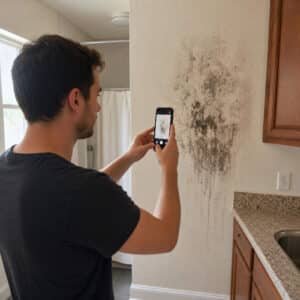
Texas mold landlord laws are clear on the duty, but they are unforgiving about process. Houston renters face one of the most mold-prone climates in the country, and apartment mold cases run year-round here. If you’ve found mold in your Houston rental, this guide breaks down what your landlord must do, what they don’t have to do, and how to protect yourself the right way.
Important: This is general information, not legal advice. Mold cases turn on specific facts and timing. If you’re considering a lawsuit, lease termination, or repair-and-deduct, talk to a Texas tenant attorney first.
Does Texas Law Specifically Cover Mold in Rental Properties?
Texas law does not have a statute that names mold directly. Instead, mold falls under the general landlord duty in Texas Property Code §92.052, which requires landlords to remedy any condition that “materially affects the physical health or safety of an ordinary tenant.” That is the legal hook for every mold case in Texas.
The Texas Attorney General’s office confirms this framing in its Renter’s Rights guide, and it’s the standard courts apply. Mold, water intrusion, plumbing leaks, and HVAC condensation all qualify when they reach a level that threatens health or safety.
There’s also no Texas law that requires landlords to disclose past mold to new tenants the same way they must disclose lead paint. The Deceptive Trade Practices Act can cover undisclosed material defects, but mold-specific disclosure is not built into the lease process.
How Long Does My Landlord Have to Fix Mold in Texas?
Seven days is generally considered a reasonable amount of time for a Texas landlord to repair mold after receiving proper written notice. Courts can find that a longer or shorter period is reasonable depending on severity, but seven days is the working benchmark.
Three conditions must be met before the duty kicks in:
- The tenant, their family, or their guests did not cause the mold condition
- The landlord received proper written notice of the problem
- The tenant is not behind on rent at the time of giving notice
All three matter. A tenant who is one month behind on rent, even by a few dollars, can lose the right to enforce the repair duty under Chapter 92. So can a tenant who only mentioned the mold verbally, or who caused the moisture problem themselves.
Written Notice Is Not Optional
The law expects the notice in writing, and certified mail with return receipt is the safest method. Sending notice that way actually changes the legal timeline. If the tenant sends a first notice by certified mail, return receipt, or another tracked method, the landlord must repair within a reasonable time. If the tenant uses regular mail or hands the notice over in person, the law generally requires a second written notice before the clock starts.
A text message or email saying “there’s mold in the bathroom” is not the same as written notice for legal purposes. Keep copies of everything. Date stamps matter.
What Counts as “Materially Affecting Health and Safety”?
The phrase “materially affects the physical health or safety of an ordinary tenant” is the standard Texas courts use to decide whether the landlord duty applies. There is no exact square-footage trigger and no specific mold species named in the law.
Factors that typically push a mold case across that line include visible growth on porous building materials like drywall or insulation, a musty smell that does not go away after cleaning, water damage history, and documented health symptoms in the home like persistent cough, sinus issues, or asthma flare-ups that improve when the tenant leaves the unit. A professional mold assessment with air or surface sampling makes the case much stronger.
One important Texas detail: when mold contamination covers 25 contiguous square feet or more, state law requires the work to be performed by a licensed mold remediation contractor working from a protocol written by a separate licensed assessor. That is a TDLR rule, and it’s why Houston renters dealing with serious mold need to push for licensed professionals at every step.
Can I Withhold Rent if My Landlord Won’t Fix Mold?
No. Texas does not generally allow tenants to withhold rent because of unaddressed repairs. The duty to repair and the duty to pay rent are treated as separate obligations under Texas law. A tenant who simply stops paying rent because of mold can be evicted, even if the mold case is legitimate.
The law gives tenants four real options instead:
- Repair and deduct. Limited to one month’s rent or $500, whichever is greater, for non-subsidized rentals. Requires strict adherence to the procedure in §92.0561, including a second written notice in some cases and a written notice from a local health or building official in others.
- File a repair and remedy lawsuit in justice court. Justices of the peace can order landlords to repair conditions affecting health or safety, with cost caps up to $10,000. Tenants can file without an attorney.
- Terminate the lease. If the condition materially affects health and safety and the landlord fails to repair after proper notice, the tenant can move out without penalty.
- Sue for damages. If health was harmed or property was damaged, a tenant may have a separate personal injury or property damage claim.
Each path has its own procedure. Skipping a step usually kills the claim. This is why documentation matters from the very first day mold becomes a concern.
How Do I Document Mold in a Texas Rental?
Strong documentation is the difference between a winnable case and a he-said-she-said dispute. Texas tenant attorneys typically want to see:
- Time-stamped photos and video of all visible mold and the surrounding moisture source
- Written notice to the landlord, with certified mail receipt and tracking confirmation
- Dated copies of all communications, including texts and emails about the mold
- An independent mold assessment report from a TDLR-licensed mold assessor
- Medical records showing symptoms that line up with mold exposure
- Records of any work the landlord did, including names and license numbers of contractors
For the medical piece, see a doctor if you suspect mold is affecting your health. The medical record is far more useful in court than a self-reported symptom log. This information is not medical advice. If you have health concerns, talk to your physician.
Our companion guide on how to check your apartment for mold covers the practical side: where to look, what to photograph, and how to spot the conditions before you send notice.
When Does Independent Mold Testing Strengthen a Tenant’s Case?
Independent mold testing is most useful when the landlord disputes the existence of a problem, when symptoms are present without obvious visible mold, or when a tenant plans to break a lease or sue. A licensed mold assessor inspects the unit, collects air or surface samples, and produces a written report that holds up as evidence.
The key word is independent. Tests run by the landlord, or by a remediation company hired by the landlord, have a built-in conflict of interest. A Texas-licensed mold assessment consultant who does not perform remediation has no financial incentive to find or downplay mold. That separation is required by Texas law, and it’s what makes the report defensible.
At Mold Testing Houston, we operate as an independent mold assessment company under TDLR Mold Assessment Company License ACO1245. We do not perform remediation, and we do not take referral fees for cleanup work. Every sample goes to EMSL Analytical, an AIHA-LAP accredited laboratory, and your written report is delivered within one business day of sampling. Our reports are written so a tenant, an attorney, or a justice court can read them without translation.
Pricing is a flat $550 for a standard residential inspection on units up to 2,500 square feet, covering the on-site visit, up to two lab-analyzed samples, and the written report. Additional samples are $85 each and we collect them only with your approval. The price is the same whether mold is found or not, and we do not run free inspections, because those are typically offered by remediation companies looking for cleanup contracts. For the full breakdown, see our guide to mold testing cost in Houston.
What Houston Renters Should Know About Apartment Mold
Houston’s climate makes apartment mold a near-constant issue. Gulf Coast humidity sits above the 60 percent threshold most of the year, summer cooling loads push condensation behind walls, and tropical storms bring repeated water intrusion events. Apartment buildings with shared HVAC systems and slab-on-grade construction concentrate moisture problems in ways that single-family homes don’t.
A few Houston-specific patterns we see in apartment cases:
- HVAC condensation in upstairs units. Air handlers in attic spaces drip into ceiling cavities when drain pans clog. The tenant below sees a stain on the ceiling and the unit above never knows.
- Slab leak mold. Slow leaks from supply lines under slab foundations push moisture up through baseboards and drywall. Easy to miss visually until carpet odors give it away.
- Window-wall mold after storm season. Wind-driven rain during named storms pushes water past sealants. Growth blooms inside the cavity within days.
- Bathroom exhaust failures. Many older Houston apartments vent bathroom fans into attics rather than outside, which dumps humid air into a space that already runs past 140 degrees in summer. Attic mold cascades down into ceilings.
If you’ve been through a storm event, our guide on mold testing after a Houston storm covers the inspection timeline and what to look for. If you’re considering a home purchase to escape a mold-heavy rental, the buyer’s checklist in our guide for Houston homebuyers walks through what to ask before closing.
What If My Landlord Retaliates After I Complain?
Texas law prohibits landlord retaliation against tenants who exercise their legal rights in good faith. The protection lasts six months from the date of the complaint. Retaliation can include raising rent, terminating the lease, reducing services, or filing eviction in response to a repair complaint.
A tenant who proves retaliation can recover one month’s rent plus $500 as a statutory penalty, plus court costs and attorney’s fees under Texas Property Code §§92.331 to 92.335. That is a meaningful deterrent, and it’s one reason landlords who are advised by counsel usually handle written mold complaints professionally.
Frequently Asked Questions
Does a landlord have to get rid of mold in Texas?
Yes, when the mold materially affects the physical health or safety of an ordinary tenant, the tenant gave proper written notice, the tenant did not cause it, and the tenant is current on rent. All four conditions apply. The law does not name mold specifically, so the duty attaches through the general repair obligation in Texas Property Code §92.052 rather than through a mold statute.
What should your landlord do if you have black mold?
The same thing they should do for any mold, because Texas law does not treat black mold as a separate legal category. There is no species-specific statute and no exposure limit in Texas or federal law. The landlord’s obligation is to find and fix the moisture source and remove the affected material. If the contamination covers 25 contiguous square feet or more, the work must be done by a licensed remediation contractor working from a protocol written by a separate licensed assessor. A landlord who paints over it or sprays bleach on drywall has not fixed anything.
What are considered uninhabitable living situations for a tenant in Texas?
Texas does not publish a checklist. The standard is whether a condition materially affects the physical health or safety of an ordinary tenant, which courts apply case by case. Conditions that commonly meet it include sewage backup, no running water, no heat in winter, exposed wiring, structural failure, serious pest infestation, and significant mold growth tied to an unrepaired water source. Cosmetic problems, minor wear, and conditions the tenant caused generally do not.
What can’t a landlord do in Texas?
A landlord cannot retaliate against a tenant for a good-faith repair complaint within six months, lock a tenant out except under narrow statutory conditions, shut off utilities to force a tenant out, remove doors or windows or appliances to make the unit unlivable, or seize a tenant’s property outside the specific rules on landlord liens. They also cannot ignore a properly noticed repair that materially affects health or safety.
Can a landlord evict you because of mold?
Not as retaliation for reporting it, and not within six months of a good-faith complaint. A landlord can lawfully require a tenant to vacate temporarily when remediation makes the unit unsafe to occupy, and lease terms usually address relocation in that situation. If an eviction notice arrives shortly after you reported mold, document the timing carefully and consult a Texas tenant attorney, because the sequence itself is often the evidence.
Can I stay in my house during mold remediation?
It depends on the scope. Small contained work with proper negative-pressure containment sometimes allows occupancy in unaffected areas. Larger projects, work involving the HVAC system, or anything requiring the containment of a main living space usually means relocating for the duration. The remediation contractor should tell you before work begins, and the answer should be in the written protocol. If you are a tenant, get the relocation arrangement in writing before you agree to anything.
Can you sue for mold exposure in Texas?
Tenants do bring these claims, typically as personal injury, breach of the warranty of habitability, negligence, or Deceptive Trade Practices Act claims. They are difficult cases. The hard part is causation, meaning proof that this mold in this unit caused this specific harm, which usually requires both medical evidence and environmental evidence collected while the condition still existed. An independent assessment taken before the landlord remediates is often the only environmental evidence that survives. Talk to a Texas tenant attorney about your situation, since nothing here is legal advice.
How hard is it to win a mold lawsuit?
Harder than most tenants expect, and the difficulty is rarely about whether mold was present. It is about proving the landlord knew and failed to act, proving the tenant followed the notice procedure exactly, and proving causation on any health claim. Cases that succeed tend to have a clean paper trail: dated photos, certified mail receipts, an independent assessment report, and medical records that predate the litigation. Cases that fail usually have verbal complaints, no independent testing, and evidence gathered after the unit was already repaired.
Does Texas require landlords to disclose past mold to new tenants?
Texas does not have a statute requiring mold-specific disclosure to new tenants. The Deceptive Trade Practices Act may cover known material defects, including past mold, and sellers in property sales must disclose Certificates of Mold Remediation issued within the past five years. For rental leases, the law is silent on direct mold disclosure.
Can my landlord evict me for reporting mold?
No, not within six months of a good-faith complaint. Texas Property Code §§92.331 to 92.335 prohibits retaliation tied to repair complaints. A tenant facing eviction shortly after reporting mold should consult an attorney immediately. The retaliation penalty can be one month’s rent plus $500, plus court costs and attorney’s fees.
What if I caused the mold by not running the AC or by leaving wet towels around?
If the landlord can show the tenant or their guests caused the condition, the landlord duty to repair under Chapter 92 does not apply. This is one of the most common landlord defenses in mold cases, especially in Houston where high humidity makes condensation issues complicated. A licensed mold assessor can usually identify whether the moisture source is structural or behavioral, which is exactly why an independent report matters more than photographs when this defense comes up.
Can I break my lease over mold in Texas?
You may have the legal right to terminate the lease if the mold materially affects health or safety and the landlord fails to repair after proper written notice. The process requires precise adherence to Texas Property Code Chapter 92 notice requirements. Breaking a lease without following the steps can expose you to liability for unpaid rent and damages. Talk to a Texas tenant attorney before terminating.
How much does independent mold testing cost in Houston?
Mold Testing Houston charges a flat $550 for a standard residential mold assessment on units up to 2,500 square feet, covering the on-site inspection, up to two EMSL Analytical lab-analyzed samples, and the written report. Additional samples are $85 each with your approval. We do not run free inspections, since those are typically offered by remediation companies looking for cleanup contracts. Pricing is the same whether mold is found or not.
How long does a mold inspection take?
A typical residential mold inspection in Houston takes one to two hours on site. Samples then go to EMSL Analytical, an AIHA-LAP accredited laboratory, and your written report is delivered within one business day of sampling. A Friday inspection means Monday results.
Get Independent Mold Testing in Houston
If you’re a Houston renter dealing with suspected mold, an independent assessment is one of the strongest evidence pieces you can put into a tenant file. Mold Testing Houston has served Houston since 2017 under TDLR Mold Assessment Company License ACO1245. We do mold inspection and testing only, and we never bid on remediation. That means our reports have no conflict of interest and stand up cleanly in tenant disputes, justice court filings, and lease termination cases.
One timing note worth acting on: once a landlord remediates, the environmental evidence is gone. If you are considering any formal step, get the assessment before the repair happens, not after.
Call 832-838-9387 or book an independent mold inspection online to get a clear picture of what’s actually in your unit and what the next move should be. If you want to vet us or anyone else first, our guide on how to find a mold inspector in Houston covers what to check.