If you have searched for free mold testing in Houston, you have probably seen a flood of companies promising no-cost visits. Almost all of them are mold remediation contractors, and the inspection is the front end of a sales process for the cleanup work. That is not automatically bad, but it changes what you are actually getting and whether the result is something you can rely on for a real estate deal, an insurance claim, or a health concern.
What most people miss is that several genuinely free routes do exist, and one of them may solve your problem outright. This guide covers all of them, what a free mold test actually includes, where the catch usually is, and when paying for an independent assessment from a licensed Mold Assessment Consultant is worth the money.
What Free Mold Testing Actually Exists in Houston
Five routes to genuinely free mold testing exist in Houston, and they are worth knowing before you pay anyone. A sixth, the free inspection every remediation company advertises, is the one most people find first, and it works differently from the other five.
1. Your landlord, if you rent
Texas Property Code Section 92.052 requires a landlord to repair conditions that materially affect health and safety once you give written notice. Mold from an unrepaired leak qualifies. This costs you nothing and it addresses the moisture source rather than just documenting the growth, which is the more useful outcome. Send the notice in writing and keep a copy. Our guide to Texas mold landlord laws covers the notice requirements and what happens if a landlord does not act.
2. A free sample kit from an accredited lab
Some accredited laboratories provide sample collection kits at no charge, including EMSL Analytical, the AIHA-LAP accredited lab we send our own samples to. The kit is free. The analysis is billed per sample, and that is where the real cost sits. A kit also arrives without an outdoor control sample, so whatever count comes back has nothing to be measured against. It can confirm a spore is present. It cannot tell you whether your indoor level is elevated.
3. The Houston Health Department, for the moisture source
The department does not test for mold and does not regulate mold companies. Its indoor air quality page directs residents to the Texas Department of Licensing and Regulation instead. What it will do is act on a rental unit with a leaking roof, standing water, or an unrepaired plumbing failure as a minimum housing standards violation. That enforcement is free and it targets the cause. It will not identify what is growing or how far it has spread.
4. A TDLR complaint, if the work is unlicensed
If you believe someone is performing mold assessment or mold remediation in your building without a license, you can file a complaint with the Texas Department of Licensing and Regulation at no cost. That is a state enforcement action and it runs separately from whatever your landlord decides to do.
5. Your own walkthrough
Visible mold covering less than 25 contiguous square feet can generally be cleaned up in Texas without a licensed contractor. If you can see the growth and you already know where the water came from, sampling often adds nothing. Walk the house with a flashlight and check under sinks, at the water heater, along baseboards on exterior walls, at window sills, in the HVAC closet, and at the attic hatch.
What none of these five produce is the thing most people are actually after when they search for free mold testing: a measured spore count compared against an outdoor control, a species identification from an accredited lab, and a written report that someone else will accept. That is what an independent Houston mold inspection is for, and it is why it costs money. The sixth route, the free visit from a remediation company, sits in between, and it is worth understanding what that visit is really for.
Are Free Mold Inspections in Houston Actually Free?
Most free mold inspections in Houston are free in the literal sense (no invoice for the visit), but they are tied to a remediation quote at the end. The company sends a technician who looks for visible mold, checks moisture levels, and writes a verbal or one-page summary. If they find mold, the same company offers to clean it up for a fee that typically runs from $1,000 to $5,000 or more, depending on scope.
The visit itself costs nothing, but the business model assumes that a meaningful percentage of visits convert into remediation contracts. That is why “free” exists as a marketing offer in this industry. It is lead generation, not charity.
There is a built-in conflict of interest here that homeowners should understand before scheduling. The same company is making the call on whether mold is present, how much there is, and what the cleanup will cost. The financial incentive points toward finding more, not less.
There is no federal limit for mold, and that changes what a test means
No EPA standard or threshold limit value exists for airborne mold. There is no number a lab result can be measured against to declare a home compliant or non-compliant, and any company implying otherwise is overselling what a report can do.
What a lab result actually tells you is how the spore count inside your home compares to the outdoor air at the same property on the same day. That comparison is the entire purpose of the outdoor control sample, and it is why a test taken without one tells you very little. It is also why the health department notes that when mold growth is already visible, sampling is often unnecessary. If you can see it and you already know where the water came from, you may not need a lab at all. Our guide to reading a mold inspection report shows where the indoor and outdoor numbers sit on the page.
Sampling earns its cost when the answer has to convince somebody else: an adjuster, a landlord, a buyer, or a doctor. At that point it stops being a detection problem and becomes a documentation problem, which is the part a free visit from a remediation contractor cannot solve.
Why Texas Has a Rule About This
Texas takes the conflict-of-interest problem seriously enough to have written it into law. Under the Texas Mold Assessors and Remediators Rules, a company is not allowed to perform both mold assessment and mold remediation on the same project. The Texas Department of Licensing and Regulation addresses this directly: an individual or company can hold both licenses, but they cannot use both on the same job.
That separation exists for a reason. The state recognized that an honest assessment requires a party with no financial stake in the cleanup result. A licensed Mold Assessment Consultant writes the protocol, a separate licensed Mold Remediation Contractor executes it, and the consultant returns at the end to verify the work passed clearance.
This is why Mold Testing Houston has been an assessment-only company since 2017. We operate under TDLR Mold Assessment Company License ACO1245 and we do not perform remediation. When we tell a homeowner what is in their walls, there is no scope of work waiting on the other side of that conversation.
What Does a Free Mold Test Actually Include?
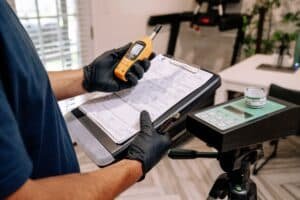
A typical free mold inspection in Houston includes a visual walk-through of accessible areas, a moisture meter reading on suspect surfaces, and a verbal summary of what the technician saw. Some companies will also use a thermal imaging camera. None of this is lab work, and none of it produces a written report you can hand to an insurance adjuster, a real estate agent, or a doctor.
Here is what is almost always missing from a free visit:
- Air sampling. Spore counts can only come from a lab analyzing a calibrated air sample. Without it, no one can say what is actually in your indoor air.
- Surface sampling. Identifying mold species by swab or tape lift requires lab analysis. Visual identification is unreliable.
- Outdoor baseline. Indoor spore counts only mean something compared to an outdoor reference sample taken the same day.
- A written report with documented findings. Insurance carriers, lenders, and attorneys want documentation, not a verbal confirmation that you have mold.
- A remediation protocol. Under TDLR rules, any licensed remediation contractor you hire must work from a written protocol prepared by a licensed Mold Assessment Consultant. A free visit from the same company that wants the cleanup cannot produce that document for its own project.
Free inspections work for one specific situation: triage. If you have visible mold and you have already accepted that you need cleanup, a remediation company’s free visit will give you a quote. That is a fine use of the offer. The trouble starts when homeowners assume that free visit is the same product as a paid independent assessment. It is not.
Is It Worth Paying for a Mold Inspection in Houston?
It is worth paying for a Houston mold inspection any time the result needs to hold up under scrutiny. That includes real estate transactions, insurance claims, post-storm damage assessments, tenant disputes, and any case where someone in the home is having health symptoms that might be mold-related. Our guide on whether a mold inspection is worth it covers the situations where you can skip it.
An independent assessment from Mold Testing Houston costs a flat $550 for a standard residential inspection up to 2,500 square feet. That includes:
- A full visual inspection from attic to crawl space
- Moisture mapping and thermal imaging on all suspect surfaces
- Up to two lab-analyzed samples, including air sampling with an outdoor control, analyzed by EMSL Analytical, an AIHA-LAP accredited lab
- Surface sampling where visible growth is present
- A written report with lab results and plain-language interpretation, delivered within one business day
- A remediation protocol if cleanup is needed, priced separately starting at $750
Additional samples beyond the first two are $85 each and we collect them only with your approval. Properties over 2,500 square feet are quoted individually, so call 832-838-9387 with the square footage.
Compared to the cost of a wrong call, the math usually works out. A $550 inspection that catches an attic mold problem before a buyer’s lender backs out, or that documents a covered loss for an insurance claim, has paid for itself many times over. Our mold testing cost guide breaks down pricing across inspection types.
When a Free Mold Test Is Fine, and When It Isn’t
A free mold inspection in Houston is fine if you already know you have visible mold, you are shopping remediation quotes, and you understand that the visit is not going to produce a report. Get three quotes, ask each company what is included, and pick based on price and credentials.
A free inspection is not fine if any of these are true:
- You are buying or selling a home. A real estate transaction needs documented findings from someone with no stake in the outcome.
- You are filing an insurance claim. Carriers expect lab-verified results from a licensed assessor.
- Someone in the home has health symptoms. A doctor needs to know what species and what concentration. Visual identification does not get you there.
- You suspect hidden mold but do not see anything. Air sampling is the only way to detect spores behind walls or in HVAC systems.
- You have had post-storm water damage. Mold can colonize behind drywall within days of water intrusion, and documentation matters for both insurance and resale value.
- You are a renter dealing with a landlord dispute. An independent assessment puts the findings on the record.
The decision really comes down to what you need the inspection to do. If you need a yes or no triage from a contractor who is going to bid on the cleanup, free is fine. If you need a result you can hand to anyone, whether an insurer, a buyer, a doctor, or a judge, pay for the independent assessment. Our guide to finding a mold inspector in Houston goes into more detail on credentials and what to look for.
How To Vet a Mold Inspector in Houston
Before scheduling any inspection, free or paid, verify the company’s license through TDLR’s online license search. Mold Assessment Technicians, Mold Assessment Consultants, and Mold Assessment Companies all show up there. If a company cannot produce a license number on request, walk away. Ours is ACO1245, and we would rather you check it than take our word for it. Our guide to mold testing companies in Houston shows how to tell a local firm from a national booking service.
Other questions worth asking before you book:
- Do you perform mold remediation, or only assessment? If both, Texas law bars them from doing both on your project anyway.
- Will I receive a written report with lab results?
- What lab do you use, and is it accredited?
- How long does it take to get the report after the visit?
- What is included in the base price, and what is extra?
Mold Testing Houston has worked these neighborhoods since 2017, and a clear answer to all five of these questions is something you should expect from any company you are considering, not just us.
Free Mold Testing Houston FAQs
Can you get mold tested for free?
Genuinely free mold testing, meaning lab-analyzed air or surface samples at no cost, essentially does not exist in Houston. Lab analysis costs real money per sample, so nobody gives it away. What you can get for free is a visual walk-through from a remediation company hoping to win the cleanup job, a repair from your landlord under Texas Property Code Section 92.052, a sample collection kit from a lab (analysis billed separately), or health department enforcement on the moisture source in a rental. If what you need is testing, meaning spore counts, species identification, and a written report, that is a paid service from an independent assessor.
Who do I report a mold problem to in Houston?
It depends on what the problem is. For a landlord who will not repair the moisture source, the Houston Health Department can act on it as a minimum housing standards issue, and Texas Property Code Section 92.052 gives you a separate repair remedy once you have given written notice. For a company performing mold assessment or remediation without a license, the complaint goes to the Texas Department of Licensing and Regulation, which is the agency that licenses and enforces both. The health department does not regulate mold companies and cannot act on that.
Is there a legal limit for mold levels in a home?
No. There are no EPA standards and no threshold limit values for airborne mold concentrations, so no lab result can declare a home compliant or non-compliant with a federal standard. A result is meaningful only as a comparison: indoor spore counts against an outdoor control sample taken at the same property on the same day. Any report that presents a number as a pass or fail against a national limit is describing something that does not exist.
How accurate are home mold test kits?
It depends entirely on the kit. Retail settle-plate kits, the ones with a petri dish you leave open on a counter, tell you very little. Something almost always grows, because mold spores are present in every building on Earth, and a visual result cannot identify species or measure concentration. Mail-in kits that send a swab or tape lift to an accredited laboratory are a different product and can identify what a specific visible spot actually is. What no kit provides is an outdoor control sample taken at your property on the same day, which is the only thing that shows whether your indoor levels are elevated, or a moisture investigation that finds where the water is coming from. Those two pieces are what a full assessment adds, and they are usually what an adjuster or a lender is looking for.
Will insurance pay for a mold test?
Sometimes. If the mold stems from a sudden, covered water event like a burst pipe or documented storm damage, many Texas policies cover testing and remediation up to the policy’s mold limit. Carriers generally will not pay based on a remediation company’s verbal opinion. They want lab-verified findings and a written report from a licensed assessor. Long-term humidity and maintenance issues are typically excluded, so check your policy’s mold endorsement before assuming either way.
Why do mold remediation companies offer free inspections?
Free mold inspections are a lead-generation tool for remediation services. The visit costs the company very little, but the back-end remediation contracts, typically $1,000 to $5,000 or more, make the program profitable. The visit is real, but it is structured to identify cleanup work, not to give an unbiased assessment.
Does Mold Testing Houston offer free mold inspections?
No. Mold Testing Houston is an independent assessment-only company, which means we charge for our inspection at a flat $550 for a standard residential assessment and do not perform mold remediation. That structure exists specifically so our findings carry no conflict of interest, which is what makes them defensible for insurance claims, real estate transactions, and health-related testing.
Can I test for mold myself?
You can inspect for mold yourself and it is worth doing, but self-inspection tells you whether to call someone rather than replacing the call. Our guide on how to test for mold walks through what you can check on your own and where the limits are.
How much does a mold inspection cost in Houston?
A flat $550 through Mold Testing Houston for homes up to 2,500 square feet, including lab-analyzed samples with an outdoor control and a written report within one business day. Our Houston mold testing cost guide breaks down what drives pricing across inspection types.
What can I do if I can’t afford mold removal?
Start by confirming what you actually have, because many mold problems are really moisture problems solved by a plumbing repair or humidity control, and small areas can legally be cleaned by the homeowner in Texas. Our guide on checking whether a Houston remediation quote is fair covers how a written protocol keeps a contractor from adding scope on their own judgment.
Where can I find mold detection services in Houston, Texas?
Start with the TDLR license search rather than a search engine, because it is the only source that confirms a license is current, then narrow by whether the company performs remediation. Mold Testing Houston operates under license ACO1245 and serves the Greater Houston metro, including Katy, Sugar Land, Memorial, Spring, and The Woodlands.
Schedule an Independent Mold Inspection in Houston
If you have been searching for free mold testing in Houston and you have realized you actually need a documented, lab-verified result, we can help. Our flat $550 inspection includes everything a real estate transaction, insurance claim, or health-driven test requires, with results in one business day and no remediation upsell on the back end, because we do not do remediation. Book online, call 832-838-9387, or contact Mold Testing Houston with questions first.
Mold Testing Houston serves the entire Greater Houston metro, including mold inspection in Katy, Fulshear, Cinco Ranch, and surrounding Fort Bend County communities, with same-day appointments often available.