A commercial mold inspection in Houston usually starts with a complaint rather than a smell. A tenant complains, an employee files something in writing, or a lender asks for documentation before closing. By then the question is no longer whether mold exists. It is what you can prove, and who signed it.
This guide covers what OSHA actually requires, how testing works in a larger building, which documents matter, and what it costs.
Is Black Mold an OSHA Violation?
No, and the reason matters. OSHA has never set a mold-specific standard, and it has no exposure limit for mold or mold spores. Its own guidance states plainly that no federal agency publishes a threshold for airborne mold concentrations.
What applies instead is the General Duty Clause, Section 5(a)(1) of the OSH Act. That clause requires employers to provide a workplace free from recognized hazards likely to cause death or serious physical harm. Mold in a building you control counts as a recognized hazard once you know about it.
So the exposure is not “you had mold.” It is “you knew and did nothing.” OSHA’s own bulletin on mold in the workplace is careful about this: failing to follow its recommendations is not itself a violation, because citations have to rest on actual standards and regulations.
The practical takeaway for a Houston property manager is simple. Document the complaint, document the assessment, document the correction. A dated third-party report showing what you found and what you did is the record that answers the question later.
How Do You Test for Mold in a Commercial Building?
The method is the same as a home. The scope is not.
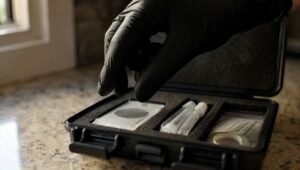
A licensed assessor walks the building, maps moisture with meters and thermal imaging, and collects samples where the evidence points. Air samples measure airborne spores. Surface samples identify what is growing on something visible. Every sample gets compared against an outdoor control taken the same day, because a spore count means nothing on its own. Our guide to air sampling vs surface sampling covers when each one is the right call.
Four things change in a commercial building:
- Sample count goes up. A 40,000 square foot building needs more sampling points than a house. Complaints are often clustered in one zone, so we sample the affected area and a control area inside the building as well.
- HVAC becomes the main suspect. Shared air handlers move spores between tenants and floors. In Houston, condensate pans and sweating ductwork drive a large share of what we find.
- Occupancy limits access. Inspections often run after hours so operations continue and occupants are not disturbed while sampling.
- The report has a wider audience. Tenants, insurers, lenders, attorneys, and contractors may all read it. It gets written accordingly.
One nuance worth knowing: OSHA notes that when mold growth is already visible, sampling is often unnecessary to decide on cleanup. Testing earns its keep when the source is hidden, when you need to compare conditions before and after work, or when you need a document somebody else will accept.
How Is a Commercial Inspection Different From a Residential One?
The inspection itself is largely the same. The obligations around it are not.
In a home, the owner decides what to do with the findings. In a commercial building, you may owe a duty to employees under OSHA, a duty to tenants under your lease, and a duty to a lender under a loan condition. Three audiences, one report.
The two rule sets also use different numbers, and people mix them up constantly:
- Texas TDLR: 25 contiguous square feet. Past that threshold, a licensed remediation contractor must do the work, following a written protocol from a separate licensed assessor.
- OSHA: tiered levels. Under 10 square feet, 10 to 30, 30 to 100, and over 100 contiguous square feet. These tiers set worker protection requirements such as containment and respirators.
They answer different questions. The Texas number tells you who is legally allowed to do the work. The OSHA tiers tell you how workers have to be protected while they do it. A 60 square foot problem clears the Texas licensing threshold and lands in OSHA’s Level III at the same time.
The Documentation a Property Manager Actually Needs
Most guides describe the inspection. Almost none explain the paperwork, which is the part that resolves the complaint.
- The assessment report. What was found, where, spore counts against an outdoor control, moisture readings, photos, and a recommendation. This is your dated record.
- The remediation protocol. A written scope a licensed contractor follows. Required in Texas past 25 contiguous square feet. It also lets you bid the job line by line instead of comparing three different descriptions of the same work. See what goes into a mold remediation protocol.
- Clearance testing. Independent verification after the work that the area actually passed. This is the document tenants and insurers care about, because a contractor saying the job is done is not evidence. Read more on clearance testing in Houston.
- The lab accreditation. OSHA points to AIHA’s Environmental Microbiology Laboratory Accreditation Program as the standard for microbial labs. Ask which lab reads your samples and whether it holds that accreditation. Ours is EMSL Analytical, AIHA-LAP accredited.
Keep all four together. When somebody asks what you did about the complaint, that file is the answer.
What Does a Commercial Mold Inspection Cost in Houston?
Our standard inspection is a flat $550. That covers the on-site visit, up to two lab-analyzed samples, and the written report, for properties up to 2,500 square feet.
Most commercial properties run larger, so we quote those directly. Call 832-838-9387 with the square footage and the nature of the complaint and you get a number before anyone shows up. Additional samples are $85 each and we only collect them with your approval. Remediation protocols start at $750 and scale with the number of remediated areas.
We publish the residential number because most Houston companies publish nothing at all. For a fuller breakdown of what moves the price, see our guide to mold testing costs in Houston.
One cost worth knowing about: Texas businesses with fewer than 250 employees at a worksite can request a free consultation through OSHA’s on-site Consultation Program. It is separate from enforcement and it does not generate citations.
When Houston Commercial Properties Need an Inspection
- A tenant or employee complaint in writing. Once it is documented, your response gets documented too.
- After any water event. Roof leak, supply line break, storm intrusion, or an HVAC failure. Houston humidity closes the window on drying fast.
- Due diligence before purchase or lease. Lab-backed answers before you sign, not after.
- Lender or insurer request. Both usually want a report from a licensed assessor with no stake in the repair.
- After remediation. Independent clearance before occupants return.
Why We Only Assess
Texas requires the licensed assessor and the licensed remediator to be separate businesses on the same project once contamination passes 25 contiguous square feet. Mold Testing Houston has been assessment-only since 2017. We never bid on cleanup work.
For a commercial property that independence is worth more than it is for a homeowner, because your report gets read by people looking for a reason to doubt it. A tenant’s attorney, an insurer, an opposing party in a lease dispute. A report from a company with no cleanup revenue is much harder to argue with.
We operate under TDLR Mold Assessment Company License ACO1245, every inspector holds an individual MAC license, and every sample goes to EMSL Analytical. If you want the full checklist for vetting any assessor, read who to call for a mold inspection in Houston.
Book a Commercial Inspection
Tell us the square footage and what prompted the call, and we will quote it before we schedule. Reports come back within one business day of sampling, formatted for tenants, insurers, lenders, and contractors.
Call 832-838-9387 or get in touch here. Same-day appointments are often available across greater Houston, and we hold Mold Assessment Company License ACO1245.