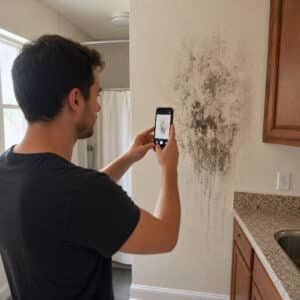
Yes, you can sell a house with mold in Texas. No Texas law stops the sale. What the law does require is honesty about what you know, plus copies of any mold remediation certificates from the last five years. The real question for most Houston sellers is which path gets the best price with the least stress: sell as-is, fix it first, or test and document before you list.
This guide walks through each option. It is general information, not legal advice. For contract or disclosure questions, talk to your real estate agent or a Texas real estate attorney.
Can You Sell a House With Mold in Texas Without Fixing It?
Yes, you can sell a house with mold in Texas without fixing it, but you still have to disclose it. Texas Property Code Section 5.008 requires most sellers of a single-family home to give the buyer a written Seller’s Disclosure Notice on or before the date the contract takes effect. The notice reflects what you know when you sign it.
The current TREC Seller’s Disclosure Notice asks about water damage not caused by a flood event and about any condition that materially affects health or safety. Known mold problems usually trace back to water, so they belong on that form. Our guide to Texas mold disclosure rules covers each line of the form and the TREC contract in detail.
If a seller signs a contract without giving the notice first, the buyer can cancel for any reason within seven days after receiving it. That is one more reason to get the disclosure right before you list.
What Are Your Options When Selling a House With Mold?
Houston sellers usually pick one of three paths. Each one trades time and money against price and buyer confidence.
| Option | What you do | What the buyer gets | Best for |
|---|---|---|---|
| Sell as-is | Disclose the mold and list without repairs | A disclosure and a question mark | Sellers who need speed over price |
| Remediate, then sell | Hire a licensed assessor for a protocol, a licensed remediator for the work, and pass clearance | A Certificate of Mold Remediation and a clearance report | Sellers with time and a known mold problem |
| Test and document | Get an independent pre-listing mold inspection with lab results | Real numbers on spore types and counts | Sellers who suspect a problem or want to get ahead of the buyer’s inspection |
Selling As-Is
Selling as-is means you disclose the mold and let the buyer decide what to do about it. Cash buyers advertise heavily for these homes across Houston. They close fast, but they also price in the unknown. When nobody knows how far the mold goes, the buyer assumes the worst.
Remediating Before You List
Fixing the mold before you sell turns an open problem into a closed one. Texas sets up a clear paper trail for this. A licensed mold assessment consultant writes a mold remediation protocol that spells out the work. A separate licensed remediator does the work. Then the assessor runs a clearance test to confirm it worked.
Texas does not let the same company assess and remediate the same project, according to the TDLR mold licensing FAQ. That split protects you. The company that tests the house has no reason to find more mold than there is.
Testing and Documenting First
A pre-listing mold inspection tells you what is really there before a buyer’s inspector finds it. If the results come back normal, you have a lab report to share. If they show a problem, you can decide on repairs on your own schedule instead of in the middle of a deal.
What Is a Certificate of Mold Remediation, and Do You Have to Give It to the Buyer?
Yes, Texas sellers must give buyers a copy of every Certificate of Mold Remediation issued for the property in the five years before the sale. Texas Occupations Code Section 1958.154 sets this rule.
The licensed remediator gives the property owner this certificate within 10 days after finishing the work. When the licensed assessor confirms that the cause of the mold (such as the leak) has also been fixed, the certificate says so. For a buyer, that line matters. It shows someone fixed the water problem, not just the mold you could see.
A do-it-yourself cleanup does not come with this certificate. TDLR says only a licensed remediator can issue one. If you cleaned up mold yourself, you still disclose what you know, but you will not have the same proof to hand the buyer.
Does Mold Lower a Home’s Value in Houston?
Mold lowers what buyers are willing to pay mostly because of uncertainty. A buyer who sees “water damage” on a disclosure with no test results has to guess how big the problem is. Lenders, insurers and inspectors ask the same question.
Documentation shrinks that guess. An inspection report with lab results, a remediation protocol, a Certificate of Mold Remediation and a passed clearance test answer the questions a buyer would otherwise ask during the option period. Every answer you bring to the table is one less reason for the buyer to ask for a price cut or walk away.
Should You Get a Mold Inspection Before Selling Your House?
You should get a mold inspection before selling if you know about past leaks, see staining, smell mustiness or had storm or plumbing water in the house. Houston’s humidity means a small leak can turn into mold fast. Our post on how long it takes mold to grow after water damage explains the timeline.
Buyers will likely test anyway. Many Houston buyers order their own inspection during the option period, and our guide for Houston home buyers tells them to. When you test first, you control the timing and the story.
What a Pre-Listing Mold Inspection Includes
Mold Testing Houston has done assessment-only work across the Houston area since 2017. We hold TDLR Mold Assessment Company license ACO1245, and every report comes from a licensed Mold Assessment Consultant. A standard inspection includes:
- A visual inspection of the home, with moisture and humidity readings
- Air or surface samples analyzed by EMSL Analytical, an AIHA-LAP accredited lab
- A written report with spore types and counts, delivered in one business day
- A $550 flat inspection price
Because we never do remediation, we have nothing to sell you after the test. If the house needs work, we write the protocol (starting at $750) and come back for clearance testing after remediation (starting at $750). That gives you the full set of documents a buyer wants to see.
What Happens If a Buyer Finds Mold After Closing?
A buyer who finds mold after closing will usually look back at the Seller’s Disclosure Notice and any reports from the sale. Our article on finding mold after buying a house in Texas covers that side of the deal. For sellers, the takeaway is simple: disclose what you know, keep every report and certificate, and ask your agent or attorney about anything you are unsure of.
Selling a House With Mold FAQs
Can you sell a house with mold in Texas?
Yes. Texas law does not stop the sale, but sellers must disclose what they know on the Seller’s Disclosure Notice and give buyers copies of any Certificate of Mold Remediation from the last five years.
Do I have to fix mold before selling my house in Texas?
No. You can sell as-is if you disclose the mold. Fixing it first with a licensed protocol, licensed remediation and a passed clearance test gives buyers proof the problem is solved.
How long do I have to give buyers a Certificate of Mold Remediation?
Texas sellers must give the buyer a copy of every certificate issued for the property in the five years before the sale (Texas Occupations Code Section 1958.154).
Can the same company test and remove mold in Texas?
No. TDLR does not allow one company to do both mold assessment and mold remediation on the same project.
How much is a pre-listing mold inspection in Houston?
Mold Testing Houston charges $550 flat for a mold inspection, with lab results and a written report in one business day.
Ready to Sell With Proof Instead of Questions?
A clear mold report helps you price your Houston home with confidence and answer buyer questions before they come up. Call Mold Testing Houston at 832-838-9387 or book your inspection online. You can also reach us through our contact page.