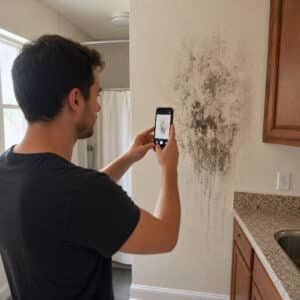
Mold in new construction homes catches buyers off guard because everything looks perfect. The drywall is fresh, the paint is new, and the house has never had a leak you know about. But a brand-new house can hold water from the build itself, and Houston’s humidity gives that water nowhere to go.
Mold Testing Houston has provided independent mold assessment across greater Houston since 2017. We never bid on remediation, so our report gives you facts to take to your builder instead of a sales pitch.
Why Do New Construction Homes Get Mold?
New construction homes get mold when moisture gets trapped before the walls close, or when the finished house can’t control its humidity. These are the usual sources:
- Framing that got rained on. If rain soaks the lumber and the drywall goes up before it dries, that water stays inside the wall.
- Window and door flashing gaps. A small gap lets wind-driven rain into the wall during the first big storm.
- Attic ductwork. Most Houston homes run their air handler and ducts through a hot attic. A duct that isn’t well sealed or insulated sweats when cold air meets humid attic air.
- An AC that can’t dry the air. A system that cools the house too fast can shut off before it removes much moisture, so the air feels cool but stays damp.
- Grading and drainage. Soil that slopes toward the slab sends rainwater to the foundation instead of away from it.
Any of these can show up in the first year. Inside the walls, the growth often stays hidden until a smell or a stain gives it away. Here’s how to tell if there’s mold behind walls without opening them up.
How Common Is Mold in New Construction Homes?
Nobody tracks how often new homes get mold, so be wary of any statistic you see. Even industry articles on the topic admit the hard data is thin.
What we can say for sure: mold needs moisture, and new homes carry specific moisture risks in their first year. The house is tight, the materials may still be drying, and the HVAC system hasn’t proven itself through a Houston summer yet.
Is It Normal to Get Mold in a New Build?
No, visible mold growth in a new build isn’t normal. Mold spores float in the air of every house, new or old, but growth on drywall, framing, or ductwork means the house has a moisture problem.
That moisture problem is the builder’s to fix if it comes from how the house went together. Cleaning the spot yourself without finding the water just resets the clock.
Does Turning the AC Off Cause Mold?
Turning the AC off in a closed-up Houston home can lead to mold, because the humidity climbs once the system stops pulling moisture out of the air. The EPA recommends keeping indoor humidity below 60 percent, ideally between 30 and 50 percent.
This catches new owners during the gap between closing and move-in, or when a finished home sits empty with the thermostat set high. Keep the AC running at a moderate setting, and check the humidity with an inexpensive meter if the house sits vacant.
Does a New Home Inspection Check for Mold?
A standard new home inspection doesn’t include mold testing. The Texas Real Estate Commission says a home inspector can’t perform mold inspections under a TREC license, because the Texas Department of Licensing and Regulation regulates mold work.
Your home inspector can note visible moisture or staining. Sampling, lab analysis, and a mold assessment report take a TDLR-licensed assessor. Our guide to mold inspection before buying a house in Houston covers how the two inspections fit together.
When Should You Test a New Construction Home?
Test a new construction home before you close if your contract allows inspections, and again before your warranty window ends. These are the moments that matter:
- Before closing. Problems found now go on the builder’s punch list instead of your repair bill.
- Before your warranty runs out. If your builder warranty includes a one-year workmanship period, book a check around month 11 so you can report anything while it’s still covered.
- Any time you notice a musty smell, a stain, or a leak. Don’t wait for the warranty checkup.
Closing on a new build in Katy? Our mold inspection in Katy covers the attic, the HVAC system, and every wall where readings point, with lab results within one business day of sampling.
What Should You Document for Your Builder?
Document everything in writing before anyone starts repairs. Builders handle warranty claims through their own process, and a clean paper trail keeps your claim moving.
- Photos and video of the growth, any stains, and the area around it, with dates.
- Moisture readings and a lab report from an independent assessor who has no stake in the repair.
- A written notice to the builder that follows your warranty’s steps, with copies of everything you send.
- A record of every reply, visit, and repair the builder makes.
Attic duct problems show up in older homes too. Our guide to Houston attic mold explains what drives them. Questions about your legal rights against a builder belong with a Texas real estate attorney.
Get Facts Before You Call the Builder
If your new home smells musty or you’ve spotted growth, an independent assessment gives you measurements and lab results your builder can’t wave away.
Mold Testing Houston operates under TDLR Mold Assessment Company license ACO1245. A flat $550 inspection covers moisture mapping, thermal imaging, up to two lab-analyzed samples against an outdoor control, and a written report within one business day of sampling. Same-day appointments are often available.
Book online, call 832-838-9387, or contact us and tell us when you closed.