Mold air sampling vs surface sampling is one of the first decisions Houston homeowners face when they call an inspector. Both methods produce lab results. Both are standard professional work. But they answer different questions, and picking the wrong one means paying for a test that does not tell you what you actually need to know.
Most guides on air vs surface sampling stop at the technical difference. This one goes further, because in Texas the choice carries legal weight that changes what a sample has to accomplish.
Air vs Surface Sampling at a Glance
| Air sampling | Surface sampling | |
|---|---|---|
| How it works | A calibrated pump pulls a measured volume of air through a spore trap cassette | A swab or tape lift is taken directly from a visible spot |
| What it answers | How many spores per cubic meter are in the air, and how that compares to outdoors | What is growing on this one specific spot |
| Best used for | Hidden growth, musty odor with nothing visible, HVAC concerns, clearance after remediation | Confirming a visible patch is actually mold, species identification before cleanup |
| Limitations | A moment in time. Counts shift with weather, humidity, and whether the HVAC is running | Tells you about that spot and nothing about the rest of the room |
| Outdoor control required | Yes. Same day, same property. Without it the number means nothing | No |
| Role under Texas rules | The basis for clearance. Post-remediation verification is decided on air results against an outdoor baseline | Supports the scope written into a remediation protocol, but does not establish clearance on its own |
| Cost at Mold Testing Houston | Covered by the flat $550, which includes up to two lab-analyzed samples | Drawn from the same two-sample allowance. Beyond two, $85 each with your approval |
What Is Air Sampling for Mold?
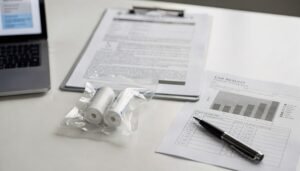
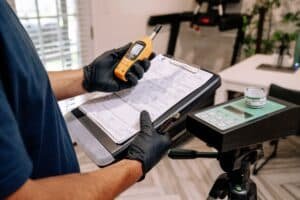
Air sampling for mold measures the concentration of mold spores floating in the indoor air. A licensed inspector uses a calibrated air pump to pull a measured volume of air through a sticky-surface cassette, often called a spore trap. The cassette is sealed and sent to an accredited lab, where a microscopist identifies and counts the spores trapped on the slide.
Results come back as spores per cubic meter of air, broken out by mold genus. Common genera that appear on most reports include Cladosporium, Aspergillus, Penicillium, and Stachybotrys, plus water-damage-indicator species that signal a specific moisture problem.
The most important detail about air sampling is that the numbers only mean something in comparison to an outdoor baseline taken on the same day at the same location. There are no federal standards for indoor mold spore counts. Without an outdoor control, indoor readings have no reference point. A licensed inspector always takes at least one outdoor sample alongside the indoor samples for this reason.
What Is Surface Sampling for Mold?
Surface sampling for mold identifies what is growing on a specific spot of visible suspected mold. There are two main methods. A tape lift uses clear adhesive tape pressed against the suspect area and pulled off, capturing spores and growth structures for direct microscopic examination at the lab. A swab uses a sterile cotton-tipped applicator wiped across the area, then sealed in a tube for analysis.
Surface sampling answers a yes-or-no question: is this thing on my wall actually mold, and if so, what type? It does not measure how much mold is in the air, and it does not tell you whether the growth is producing airborne spores at exposure-relevant levels. It tells you what the spot is.
This matters because not everything that looks like mold is mold. Soot from candle burning, alkaline crystals on concrete, water-damage staining without active growth, and certain types of paint deterioration can all be mistaken for mold visually. Surface sampling confirms the call before a homeowner spends thousands on remediation that may not be needed.
When Should You Use Air Sampling?
Air sampling is the right call in these scenarios:
- No visible mold but you suspect a problem. Musty smells, health symptoms that improve when you leave the house, or recent water damage with no obvious visible growth all point to air sampling as the first move. Hidden mold inside wall cavities, under floors, or above ceilings releases spores into living spaces even when nothing is visible.
- Health symptoms in the home. If anyone in the household is experiencing persistent respiratory symptoms, headaches, or allergic reactions that resolve elsewhere, air sampling characterizes the exposure level. This information is not medical advice. Talk to a physician about symptoms.
- Post-remediation clearance testing. After mold remediation, an independent air sample confirms the work is complete. The EPA notes that surface sampling may be useful to confirm an area has been adequately cleaned, but air sampling is the standard for clearance because it measures what residents will actually breathe. Our clearance testing service uses air sampling as the primary method.
- Real estate transactions. A buyer or seller who needs documented air quality for disclosure or negotiation purposes typically wants air sampling. The report becomes part of the transaction file.
- HVAC concerns. Mold in air-handling equipment distributes spores throughout the home. Air sampling in different rooms identifies whether the HVAC system is acting as a distribution path.
The common thread: air sampling is the right call when the question is “is there an exposure problem I cannot see?”
When Should You Use Surface Sampling?
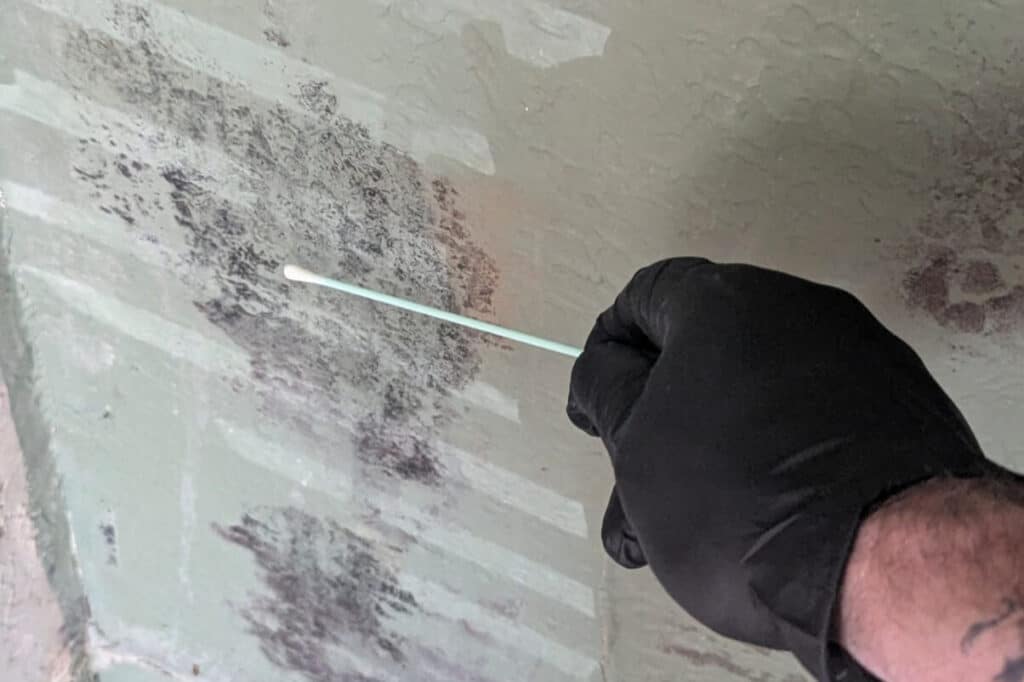
Surface sampling is the right call when you already see something that might be mold and you need to know what it is. Specifically:
- Visible suspected mold on a wall, ceiling, baseboard, or other surface. Tape lifts or swabs identify the species, which tells you whether you are dealing with common indoor molds, water-damage-indicator molds, or species that warrant more concern.
- Confirmation before remediation. A property manager or homeowner about to commit to a remediation budget can save thousands by surface-testing first to confirm the growth is actually mold and not something cosmetic.
- Documenting a specific contamination location. In real estate disputes, insurance claims, or landlord-tenant cases, the documented species and location of visible growth can matter for the legal record.
- Species identification for medical context. If a physician is investigating a possible mold-related illness, identifying the specific species growing in the home can inform the conversation.
The common thread: surface sampling is the right call when the question is “what is this specific visible thing?”
When Do You Need Both Air and Surface Sampling?
Most professional Houston mold inspections use both methods on the same visit. Here is why both make sense in the most common scenarios:
- Real estate transactions with visible mold. The buyer wants to know what is on the wall (surface) and how much is in the air (air). One answer alone is incomplete for negotiation.
- Post-water-event inspections. After a slab leak, plumbing failure, or storm-related water intrusion, surface sampling identifies any visible growth that developed and air sampling tells you whether hidden growth is contributing to airborne levels. Our slab leak mold testing guide walks through the timing of these tests after a leak repair.
- Insurance claim documentation. An insurance adjuster benefits from both species identification and airborne concentration data. A combined report is harder for an adjuster to dismiss than a single-method test.
- Properties with previous mold history. Surface sampling confirms whether visible spots represent active growth or old staining, while air sampling shows whether the historical issue is still affecting current air quality.
For most Houston residential inspections involving any visible suspect mold, the combined approach is what professional inspectors recommend.
What Texas Rules Mean for Your Sampling Choice
In most states, air vs surface sampling is a technical preference. In Texas it is not, because the sample has to support whatever happens next, and what happens next is defined by state rule.
The Texas Department of Licensing and Regulation defines mold assessment as inspecting a structure and developing the remediation plan, while mold remediation covers the removal and cleaning itself. Those are two separate licenses, and one company cannot hold both roles on the same project. That structure creates three practical consequences for how your home gets sampled.
- The protocol is written against your findings. Before a licensed remediation contractor can legally begin, a licensed Mold Assessment Consultant has to produce a written remediation protocol. That document defines the scope of work and the criteria the job has to meet. Vague sampling produces a vague protocol, and a vague protocol is what lets a contractor add scope on their own judgment.
- Clearance rests on air results. When the cleanup finishes, the assessor returns to verify it worked. That determination compares indoor spore counts against an outdoor control taken the same day. A sample collected without an outdoor control cannot support a clearance decision, no matter how good the lab is.
- The 25 square foot threshold changes the stakes. Visible mold covering less than 25 contiguous square feet can generally be handled without a licensed remediation contractor in Texas. Knowing which side of that line you are on determines whether you need the documentation chain at all, and finding out is an assessment question, not a guess.
This is also why an assessment-only company gives you a cleaner answer. Mold Testing Houston has operated under TDLR Mold Assessment Company License ACO1245 since 2017 and has never performed remediation. When our sampling plan calls for more, there is no cleanup contract waiting on the other side of that recommendation.
What About Bulk Sampling?
Bulk sampling is a third method most homeowners do not need to think about, but it is worth knowing about. A bulk sample is a small piece of the actual building material, typically drywall, insulation, or wood, that gets sent to the lab for direct examination.
Bulk samples come into play primarily for remediation contractors who need to know how deep into a material the contamination extends. They tell the contractor whether a wall section can be cleaned in place or whether the material has to be removed entirely. They are not typically part of a homeowner-initiated inspection, but they can show up in scope-of-work documentation for larger remediation projects.
Why the Outdoor Baseline Sample Matters
An air sampling report without an outdoor baseline comparison is essentially useless for interpretation. This is one of the most important things Houston homeowners should know before paying for any mold test. Our guide on how to read a mold inspection report shows where that comparison appears in your results.
Mold spores are everywhere outdoors. That is normal. They float through the air, drift in through open doors and windows, and ride in on shoes and clothes. A measurable indoor spore count by itself proves nothing, because some indoor count is unavoidable.
The meaningful question is whether indoor levels are elevated relative to outdoor levels on the same day, or whether the indoor sample contains species that do not appear in the outdoor sample. Either pattern points to an indoor source. Without the outdoor control, neither comparison is possible.
If a Houston inspector quotes you a price for air sampling that does not include an outdoor control sample, that is a warning sign. The standard professional approach always includes at least one outdoor comparison sample. The cost difference is minimal, and the report without it is not defensible.
What Does Mold Sampling Cost in Houston?
Mold Testing Houston charges a flat $550 for a standard residential mold assessment. That number covers the on-site inspection, moisture readings, up to two lab-analyzed samples with an outdoor control, lab analysis at an accredited lab, and the written report.
Most of the industry prices sampling per sample instead, commonly quoted around $150 to $300 for each air sample and $75 to $150 for each surface sample, with lab fees on top. Under that model a two-sample visit plus lab work can approach or pass the flat $550 before anyone has charged you for the inspection itself.
Samples beyond the standard two are $85 each here, and we collect them only after asking you first. That $85 sits close to what the lab analysis actually costs and well under the industry per-sample range. The approval step is the part that matters most: no sample lands on your invoice without your say-so, so the sampling plan reflects your situation rather than the size of the bill.
We also do not run “free” inspections that hide costs in the lab work.
Your written report arrives within one business day of sampling. A Friday inspection means results on Monday. Many providers quote several business days or longer for lab turnaround, and some market a two-day turnaround as a premium. Ours is one business day as standard, with samples analyzed by microscopists at EMSL Analytical, an AIHA-LAP accredited laboratory. For the full picture of how the visit itself runs, see our guide on how long a mold inspection takes.
The cheapest mold test is not worth much if it does not answer your actual question. Call us at 832-838-9387 or schedule a Houston mold inspection and we will talk through which sampling approach fits your situation before you commit.
Frequently Asked Questions
Is air sampling for mold accurate?
Yes, when it is done correctly, which means a calibrated pump measuring a known volume of air and an outdoor control sample taken at the same property on the same day. Accuracy problems come from method rather than from the technique itself. A sample without an outdoor baseline produces a number with nothing to compare it against. A sample taken with the windows open, or hours after the HVAC last ran, captures conditions that are not representative. The lab work is reliable. The sampling plan is where accuracy is won or lost.
What is the most reliable method for testing for mold?
There is no single most reliable method, because the methods answer different questions. Air sampling is the most reliable way to measure what you are breathing. Surface sampling is the most reliable way to identify what a specific visible patch is. Neither locates the moisture that caused the growth, which is why a moisture survey matters more than either sample on its own. The most reliable approach is a licensed assessor who maps the moisture first and then samples to answer the specific question you need answered.
Does the CDC or EPA recommend routine mold sampling?
No. The EPA’s position is that sampling is often unnecessary when mold growth is already visible, because you can see the problem and the response is the same regardless of species: fix the moisture and remove the growth. Sampling earns its cost when the answer has to convince someone else, such as an adjuster, a landlord, a buyer, or a physician, or when you suspect hidden growth you cannot see. Neither agency recommends testing on a schedule.
What are acceptable levels of mold in a home?
No federal numerical standard exists, so no lab result can declare a home compliant or non-compliant. Interpretation depends on three things: how indoor counts compare to the outdoor control taken the same day, which species appear indoors that do not appear outdoors, and the condition of the home when the sample was taken. Any report presenting a number as a pass or fail against a national limit is describing a standard that does not exist.
How do you interpret mold air sampling results?
You read the indoor sample against the outdoor control, then look at species rather than just totals. A high indoor count that matches a high outdoor count on a humid Houston day usually means the outdoor air came inside, not that you have a problem. A moderate indoor count containing water-damage-indicator species such as Stachybotrys or Chaetomium, when those species are absent outdoors, matters far more than a larger number made up of ordinary background genera. Pattern beats magnitude, which is why a licensed assessor reads the report rather than handing you a threshold.
How much does an air quality test for mold cost?
Priced per sample, air testing commonly runs somewhere around $150 to $300 per sample with lab fees added separately, which is how most of the industry bills it. Mold Testing Houston uses a flat $550 for a standard residential assessment instead, covering the inspection, up to two lab-analyzed samples with an outdoor control, the lab work, and the written report in one number. Samples past the first two are $85 each and we ask before collecting any. Our Houston mold testing cost guide breaks down what drives pricing across inspection types.
Can I do mold air sampling with a DIY kit?
Not in any meaningful sense, because the retail kits sold as air tests are not doing air sampling. Most use a settle plate, an open petri dish that collects whatever happens to fall on it. A settle plate cannot measure a known volume of air, so it produces no spores-per-cubic-meter figure, and it arrives without an outdoor control sample taken at your property on the same day. Those two elements are what make an air result interpretable. Volumetric air sampling requires a calibrated pump, which is why it stays a professional method.
Can the same company do my mold testing and my mold remediation?
Not on the same project in Texas. State rule requires the licensed mold assessor and the licensed mold remediator to be separate parties on any given job. A company may hold both licenses, but it cannot use both on your project. This exists to remove the conflict of interest where the party diagnosing the problem also profits from the cure. Mold Testing Houston operates under TDLR license ACO1245 and performs assessment only.
Get Mold Sampling in Houston
Whether you need air sampling, surface sampling, or both, Mold Testing Houston handles the call so you do not have to guess. We have served Houston since 2017 under TDLR license ACO1245. We perform mold assessment and testing only. We do not perform remediation, and we are not paid to find more mold than is present. The sampling protocol we recommend is the one your situation actually needs.
Call us at 832-838-9387 or schedule a Houston mold inspection and we will walk through which sampling approach fits before you commit.