How Clearance Testing Works in Houston: Post-Remediation Verification, Explained
Clearance testing in Houston is the final, independent check that proves your mold remediation was done right. After a remediation crew finishes the cleanup, a separate licensed company comes in to verify the work before you call the job done. This step matters because the company that removed the mold should never be the same company that signs off on it. At Mold Testing Houston, we have served Houston homeowners as a TDLR-licensed assessment company since 2017, and we only do testing. We never perform remediation, which is exactly why we can give you an honest pass or fail.
This guide walks through what clearance testing is, how the process actually works in a Houston home, how long it takes, what a passing result means, and what happens when an area does not pass. If you already know you need this service, you can learn more about our clearance testing in Houston and book directly. Otherwise, keep reading.
What Is Clearance Testing and Why Is It Necessary?
Clearance testing is a post-remediation assessment that confirms mold was successfully removed from an area that was previously remediated. It is the difference between a remediation crew telling you the job is done and an independent licensed assessor proving it. Without that proof, you are taking the crew’s word for their own work.
The reason this step exists comes down to conflict of interest. In Texas, a company is not allowed to perform both the remediation and the clearance testing on the same project. The Texas Department of Licensing and Regulation enforces that separation specifically to stop remediation companies from grading their own homework. According to the Texas Department of Licensing and Regulation, a licensed mold assessment consultant must conduct a post-remediation assessment before a remediation project can be considered successful, and that assessment confirms the work area is free of visible mold, was completed in line with the protocol, and meets the clearance criteria.
Clearance testing is necessary for a few specific reasons:
- It protects your money. You paid for remediation. Clearance testing confirms you got what you paid for before you release final payment.
- It protects your health. Mold you cannot see can still affect indoor air. Air sampling catches elevated spore counts that a visual check would miss.
- It protects a real estate deal. Buyers, sellers, and lenders often require a passed clearance report before closing on a Houston home with a mold history.
- It creates a paper trail. A documented clearance report is the record you keep for insurance claims and future property sales.
Our company and our inspectors are licensed by TDLR under Mold Assessment Company license ACO1245, which is what allows us to issue these reports in Texas.
How Is Clearance Testing Conducted in a Houston Home?
Clearance testing is conducted in four steps: a visual inspection, moisture and humidity readings, air and surface sampling, and a lab comparison against the clearance criteria. Each step builds on the last, and a single area can fail at any one of them.
Here is what each step looks like on site:
- Visual inspection of the work area. The assessor confirms the remediation crew removed all visible mold and any wood rot, and that the containment was handled properly. Any visible growth left behind is an automatic fail.
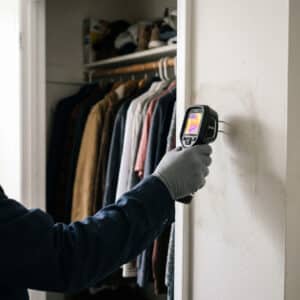
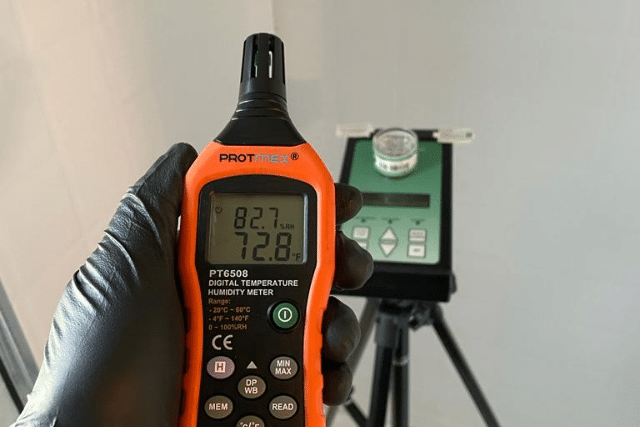
- Moisture and humidity readings. Houston’s humidity is the entire reason mold thrives here, so this step carries real weight. The assessor uses calibrated meters and thermal imaging to check that the moisture source that caused the original problem has actually been fixed. If the area is still wet, mold will simply come back, and the area should not pass.
- Air and surface sampling. The assessor collects air samples to measure airborne spore counts inside the remediated area and compares them to an outdoor baseline taken the same day. Surface samples may also be swabbed to confirm specific spots are clean.
- Lab analysis against clearance criteria. The samples go to an accredited laboratory. The results are measured against the clearance criteria that were written into the original remediation protocol, not against a vague guess.
One thing worth understanding: there is no single national or state number for a “safe” level of mold, because mold spores are always present in the air around us at some level. That is why clearance is judged against the criteria set in your specific protocol and against the outdoor baseline, rather than against a one-size-fits-all threshold. If you want a fuller picture of the testing methods involved, our overview of our mold testing services breaks down how air and surface sampling work.
How Long Does Clearance Testing Take?
The on-site portion of clearance testing usually takes one to two hours, depending on the size of the remediated area and how many samples are needed. The lab results are where the real timeline sits, and we deliver those in 24 hours. For a time-sensitive Houston closing, that 24-hour turnaround is often the difference between hitting your closing date and pushing it.
A few things affect how long the full process runs from start to finished report:
- Number of remediated areas. A single remediated room is faster than a whole-house project with multiple containment zones.
- Sample volume. More sampling locations means slightly more time on site and at the lab.
- Scheduling. Clearance can only happen after the remediation crew has fully finished and pulled their containment, so timing depends on their completion, not just ours.
We offer same-day availability for scheduling, so once the remediation work is done, you are not waiting days just to get an inspector out to the property.
What Happens If Mold Is Found During Clearance Testing?
If mold is found during clearance testing, the area fails clearance and the remediation crew has to return and correct the work before it can be retested. A failed clearance is not a disaster. It is the system doing exactly what it is supposed to do, catching incomplete work before you pay for it and move back in.
When an area fails, here is what generally happens next:
- We document the specific findings in writing, including where the problem is and what the samples showed.
- The remediation contractor goes back to address the deficiency, whether that is leftover growth, an unresolved moisture source, or elevated spore counts.
- Once they have redone the work, we come back and run clearance testing again on that area.
- Only after the area passes do you receive your passed clearance report.
Because we do not perform remediation ourselves, we have no financial reason to pass a job that should fail. Our only job is to tell you the truth about whether the area is clean. That independence is the heart of why a separate licensed assessor should always handle this step, and it is the same principle behind choosing an independent inspector for any mold assessment.
Do You Need Clearance Testing for a Small Mold Problem?
Whether you need formal clearance testing depends largely on the size of the area that was remediated. Under Texas rules, the licensing requirements kick in at 25 contiguous square feet of mold. A very small patch that a homeowner cleaned themselves is treated differently than a larger contaminated area that required a licensed remediation contractor.
That said, the square footage rule is about licensing, not about whether clearance testing is a good idea. Plenty of Houston homeowners choose clearance testing even when it is not strictly required, for three practical reasons:
- Real estate. A buyer or lender wants documented proof, regardless of how big the original problem was.
- Insurance. A carrier may require a passed clearance report to close out a mold claim.
- Peace of mind. After living through a mold problem, many homeowners simply want independent confirmation that it is truly gone before their family moves back in.
If you are not sure whether your situation calls for clearance testing, the simplest path is to call and describe what was remediated. We can tell you honestly whether testing makes sense for your specific case.
Why an Independent Company Should Handle Your Clearance Testing
The single most important factor in clearance testing is who performs it. A remediation company verifying its own cleanup has a built-in reason to call the job complete. An independent assessment company has no such pressure, which is the entire point of the separation that Texas law requires.
Mold Testing Houston is assessment-only by design. We hold TDLR Mold Assessment Company license ACO1245, we serve Houston, Dallas, and Austin, and we have never offered remediation services. When we hand you a clearance report, it reflects what the samples and the inspection actually showed, with no upsell waiting on the other side. That is the kind of result you can hand to a buyer, a lender, or an insurance adjuster with confidence.
Schedule Clearance Testing in Houston
If your remediation is finished and you need independent verification that it worked, we are ready to help. Mold Testing Houston delivers lab results in 24 hours with same-day scheduling availability, so you can keep your closing, your claim, or your move-in on track. You can contact our team to ask questions, call us directly at 832-838-9387, or book your clearance testing appointment online.