
What Does a Houston Mold Inspection Include? Services Explained
A Houston mold inspection includes far more than someone walking through your home and looking for black spots. A real professional mold inspection combines a visual assessment, moisture detection, lab-analyzed sampling, and a written report you can actually use. Knowing what is included helps you compare companies and avoid the bargain “inspections” that are really just sales calls for remediation. At Mold Testing Houston, we have served Houston homeowners as a TDLR-licensed assessment company since 2017, and every inspection follows the same thorough process.
This guide breaks down exactly what mold inspection services include in Houston, what you should expect to pay, and how to tell a complete inspection from a shortcut. If you already know you need an inspection, you can see the full scope of our mold testing services and book directly.
What Is Included in a Professional Mold Inspection?
A professional mold inspection includes four core components: a visual inspection, moisture readings, air and surface sampling, and a written lab report. Each one catches something the others miss, which is why skipping any of them leaves gaps.
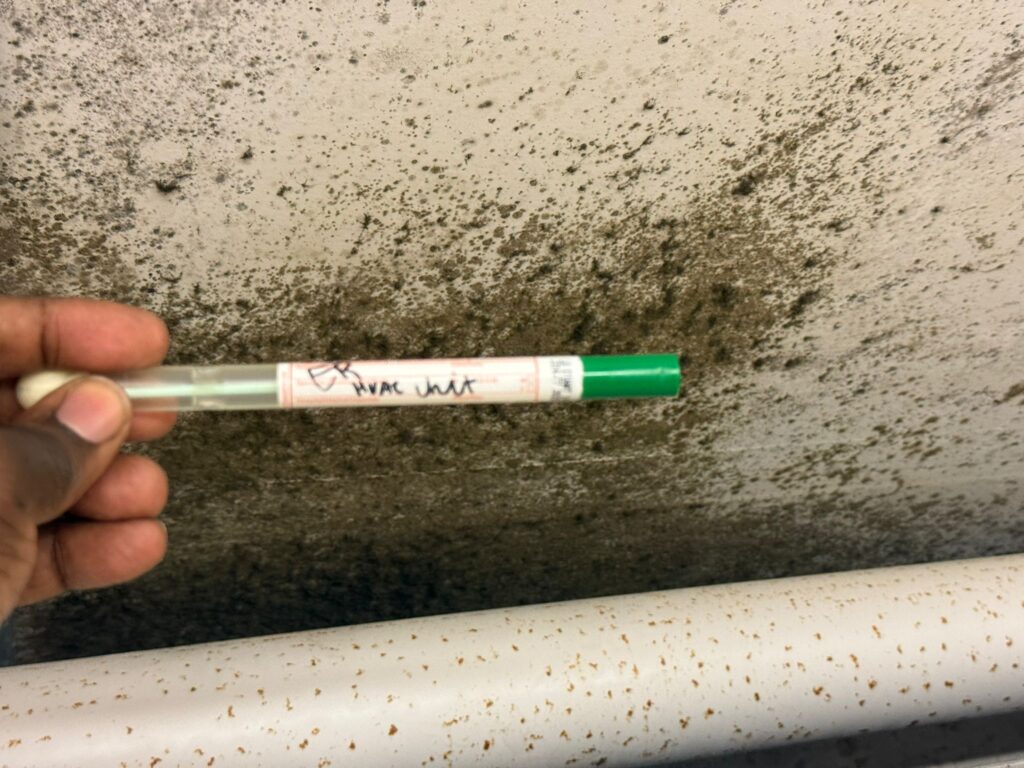
- Visual inspection. The inspector examines walls, ceilings, floors, HVAC systems, attics, and the spots under cabinets where moisture hides. This step identifies visible mold, water staining, and the conditions that let mold grow in the first place.
- Moisture and humidity readings. Using calibrated moisture meters and thermal imaging, the inspector measures relative humidity, surface moisture, and dew point throughout the property. Elevated readings behind walls or under floors point to the moisture source that is feeding the mold, even when nothing is visible.
- Air and surface sampling. The inspector collects air samples to measure airborne spore counts and swab samples from any suspected surfaces. These go to an accredited laboratory for species identification and spore-count analysis. If you are wondering how this differs from a simple visual check, our guide on mold inspection vs. mold testing breaks down the distinction.
- Written report. You receive a detailed report listing the mold types found, the affected locations, the lab results compared to an outdoor baseline, and clear recommendations on next steps.
Every Mold Testing Houston inspection is performed under TDLR Mold Assessment Company license ACO1245, and each inspector holds a Mold Assessment Consultant credential, which is the senior license for assessing mold in Texas.
How Much Do Mold Inspection Services Cost in Houston?
Mold inspection services in Houston typically range from $300 to $600 for a standard residential inspection, with larger or commercial properties running higher. At Mold Testing Houston, the inspection is a flat $550 fee with no hidden add-ons, and remediation protocols start at $750 when needed.
The price difference between companies usually comes down to what is actually included. A cheap inspection might be a visual check with no lab work, while a complete inspection covers sampling, lab analysis, and a written report. We break down the full pricing picture in our guide to how much a mold inspection costs, but the short version is that the lowest quote is rarely the best value if it skips the lab.
Why Should an Inspection Company Not Also Do Remediation?
An inspection company should not also perform remediation because it creates a direct conflict of interest. A company that profits from removing mold has a financial reason to find mold, and to recommend more removal than you may actually need. In Texas, this is not just a best practice. The Texas Department of Licensing and Regulation requires that mold assessment and mold remediation on the same project be performed by separate companies.
This is why some “free” mold inspections deserve a second look. They are often offered by remediation companies as a lead-in to a removal quote. An independent inspection from a testing-only company gives you an unbiased result, because we have no remediation services to sell you on the back end. We only test, and our report reflects what the lab and the inspection actually found.
What Does the Mold Inspection Report Tell You?
The mold inspection report tells you what types of mold are present, where they are located, how the indoor spore counts compare to outdoor levels, and what you should do next. It is the document you keep for insurance claims, real estate transactions, and your own records.
A complete report includes the lab analysis of every sample, an indoor-to-outdoor comparison so the numbers have context, the affected locations identified during the inspection, and specific recommendations. If remediation is needed, the report gives the remediation contractor the information they need to scope the work correctly rather than guessing.
When Should You Schedule a Mold Inspection in Houston?
You should schedule a mold inspection in Houston after any water event, when you notice a persistent musty odor, before buying or selling a home, or when someone in the household has symptoms that improve when they leave the house. Houston’s humidity and storm exposure make these triggers more common here than in drier climates.
Common reasons Houston homeowners book an inspection include visible mold or staining, a recent plumbing or roof leak, post-storm or post-flood concerns, a real estate transaction that needs documentation, and unexplained allergy or respiratory symptoms at home. If any of these apply, testing gives you a clear answer instead of a guess.
Schedule Your Houston Mold Inspection
If you want a complete, independent mold inspection with lab results in 24 hours, Mold Testing Houston is ready to help. We offer same-day scheduling availability and a flat $550 fee with no surprises. You can contact our team with questions, call us at 832-838-9387, or book your mold inspection online.