
<div style=”background:#f4f4f4;padding:15px;border-left:4px solid #333;margin:20px 0;”>
<strong>Quick Answer:</strong> Document everything before you touch it, find the water source, and get an independent assessment that says what is actually there. Texas requires most sellers to disclose what they knew about the property’s condition, and your own documentation is what makes that question answerable later. Do all of that before you start cleaning or repairing anything.
</div>
<p>If you found mold after buying a house, the order of what you do next matters more than the speed. The instinct is to clean it. That instinct costs people the evidence they need and usually misses the reason it grew.</p>
<p>Houston makes this common. Flood history, slab foundations, attic-mounted HVAC, and 75 percent average humidity mean a home can carry hidden moisture damage that a general home inspection never surfaced. Sellers often do not know either.</p>
<p>Mold Testing Houston has been assessment-only since 2017 under TDLR license ACO1245. We do not perform remediation and we do not do legal work. What follows is the practical sequence, and the point where you need a different professional is marked clearly.</p>
<h2>What Should I Do If I Discover Mold After Buying a House?</h2>
<p>Four things, in this order. The order is the whole point.</p>
<ol>
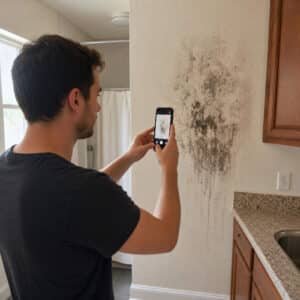
<li><strong>Photograph it before you move anything.</strong> Wide shots showing the location in the room, then close-ups. Include something for scale. You cannot recreate this later.</li>
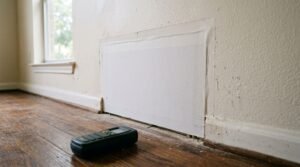
<li><strong>Find the water.</strong> Mold is a symptom. Look above and behind the growth, not at it.</li>
<li><strong>Pull your closing file.</strong> The seller’s disclosure notice, the inspection report, and any repair receipts. Read what was and was not disclosed.</li>
<li><strong>Get an independent assessment.</strong> A licensed assessor documents what is present, how far it extends, and what the moisture pattern indicates about the source.</li>
</ol>
<p>Cleaning comes after all four. Not before.</p>
<h2>Document Before You Touch Anything</h2>
<p>Whatever happens next depends on records you can only create right now.</p>
<p>Take wide photos showing where in the house the growth sits, then close-ups of the material itself. Photograph any staining, warping, bubbling paint, or separated baseboards nearby, even if they look unrelated. Most phones timestamp automatically.</p>
<p>Then write down the timeline. When you closed. When you first noticed it. What the weather had been doing. Whether the AC was running. That sequence matters more than people expect, because it helps establish whether the condition predates your ownership.</p>
<p>Keep every receipt from this point forward, including anything you spend investigating.</p>
<h2>Find the Water, Not the Mold</h2>
<p>Growth that appears shortly after closing almost always traces to a moisture source that was already there.</p>
<p>The common Houston sources, roughly in order:</p>
<ul>
<li><strong>A slab leak.</strong> These run undetected for weeks or months, and the growth shows up at the bottom of walls, along baseboards, and under flooring, often several feet from where the pipe actually failed. Our guide on <a href=”https://moldtesting-houston.com/slab-leak-mold-houston/”>mold after a slab leak</a> covers the pattern.</li>
<li><strong>An attic problem.</strong> Blocked soffit vents, a bathroom fan terminating into the attic, or a condensate line from an attic air handler. Ghosting stripes on upstairs ceilings and staining around recessed lights point here.</li>
<li><strong>A roof leak that only shows in heavy rain.</strong> Wind-driven water finds vent boots and flashing, and the decking stays damp long enough to colonize without ever dripping visibly.</li>
<li><strong>A vacant period before closing.</strong> An empty house with the AC set high in a Houston summer grows mold on surfaces without any leak at all.</li>
</ul>
<p>That last one catches people. Indoor humidity above 60 percent is enough on its own, and an unoccupied home in July gets there quickly.</p>
<h2>What Was the Seller Required to Tell You?</h2>
<p>Texas requires most residential sellers to give the buyer a written notice about the property’s condition before closing.</p>
<p><a href=”https://texas.public.law/statutes/tex._prop._code_section_5.008″ target=”_blank” rel=”noopener”>Texas Property Code Section 5.008</a> applies to sellers of residential real property comprising not more than one dwelling unit. Four parts of it are worth reading yourself.</p>
<p><strong>The notice reflects what the seller knew.</strong> Section 5.008(d) states the notice is completed to the best of the seller’s belief and knowledge as of the date it was signed. If the seller genuinely did not know, indicating that on the notice puts them in compliance. The standard is knowledge, not inspection.</p>
<p><strong>Some sales are exempt.</strong> Section 5.008(e) lists transfers where the notice is not required, including foreclosure sales, court-ordered transfers, sales by a trustee in bankruptcy or a fiduciary administering an estate, transfers between family members or co-owners, transfers to or from a governmental entity, and new construction that has not previously been occupied. If you bought through any of those, there may be no notice to compare against.</p>
<p><strong>There is a termination window if you never got one.</strong> Section 5.008(f) says the notice must be delivered on or before the effective date of the contract, and that if a contract was entered without it, the purchaser may terminate the contract for any reason within seven days after receiving the notice. Most buyers do not know that clause exists.</p>
<p><strong>The notice is not a warranty.</strong> The form itself says so, and it states plainly that it is not a substitute for inspections the purchaser may wish to obtain.</p>
<p>Read your notice against what you are now looking at. Note any item about water penetration, previous flooding, roof leaks, or prior repairs. Our guide on <a href=”https://moldtesting-houston.com/texas-mold-disclosure/”>Texas mold disclosure</a> covers the seller’s side of the same document.</p>
<h2>Can I Sue If I Bought a House With Mold?</h2>
<p>That question belongs to a Texas real estate attorney, and we are not going to answer it here.</p>
<p>Whether a specific situation supports a claim depends on what the seller actually knew, what the notice said, what your contract contained, and what your inspection covered. No statute or agency page answers it in the general case, and anyone telling you otherwise on a mold company’s website is guessing.</p>
<p>What we can tell you is what an attorney will want in hand: the seller’s disclosure notice, your inspection report, your photographs, and an independent assessment documenting what is present and where the water came from. The State Bar of Texas runs a lawyer referral service if you do not have someone.</p>
<p>Get the documentation first. It is useful whether or not you ever speak to a lawyer.</p>
<h2>Can Mold in a House Go Away on Its Own?</h2>
<p>Only if the water goes away on its own, which is rare.</p>
<p>Growth stops expanding when the moisture stops. It does not disappear. It goes dormant on the material, the spores it produced stay in the surrounding dust, and it restarts when the material gets wet again. Dried growth on porous material is still contaminated material.</p>
<p>A seasonal pattern is the tell. If it fades in winter and returns in summer, you have a humidity or condensate problem rather than a one-time event, and nothing about it will resolve itself.</p>
<h2>Do I Need to Throw Everything Away If I Find Mold in My House?</h2>
<p>No. Porous material that stayed wet goes. Almost everything else stays.</p>
<p>Drywall, insulation, carpet padding, ceiling tiles, and particleboard usually cannot be cleaned, because growth reaches into the material rather than sitting on it. Hard, non-porous items clean up and dry out: glass, metal, tile, solid wood, sealed surfaces.</p>
<p>Personal belongings without visible growth generally stay. Fabrics may need deep cleaning to remove settled spores, and anything with sentimental or high value is worth asking a specialist about rather than discarding.</p>
<h2>Is It Expensive to Have Mold Removed?</h2>
<p>Less than most buyers fear and more than they hope. Most Houston remediation jobs land between $500 and $6,000, with the typical project closer to $2,000. Whole-home work runs far higher.</p>
<p>Those ranges are wide because the price follows the scope, and the scope is a judgment call about how much of your house is affected. That is exactly why an independent assessment before you collect quotes tends to pay for itself. Our guide on <a href=”https://moldtesting-houston.com/mold-remediation-cost-houston/”>whether a Houston remediation quote is fair</a> covers what drives the number.</p>
<p>If the affected area crosses 25 contiguous square feet, Texas requires a written remediation protocol from a licensed assessor before a licensed contractor begins work, and independent <a href=”https://moldtesting-houston.com/clearance-testing-in-houston/”>clearance testing</a> afterward to confirm the job met it.</p>
<h2>Frequently Asked Questions</h2>
<h3>Should I tell the seller I found mold?</h3>
<p>That is a decision to make with your attorney or your agent rather than on your own, particularly if you are considering any claim. What is not in question is that you should document the condition thoroughly before any conversation happens, because the documentation is what the conversation will turn on.</p>
<h3>Why didn’t the home inspector catch it?</h3>
<p>A general home inspector in Texas is licensed by TREC and has no authority to collect mold samples for laboratory analysis. They can note visible growth or moisture they observe. They are not permitted to test, and they are not looking inside wall cavities. Mold assessment requires a separate TDLR license.</p>
<h3>Does my homeowners insurance cover this?</h3>
<p>Texas policies typically cover mold only when it results from a sudden, accidental, covered water event, and many policies carry a specific dollar cap. Gradual leaks and long-term humidity are usually excluded. Call your carrier before you spend anything, since some require a specific process. The Texas Department of Insurance publishes consumer guidance on how mold and water damage coverage works.</p>
<h3>How soon after closing should I test?</h3>
<p>As soon as you find something, provided the structure is not actively wet. If a leak was just repaired and drying equipment is still running, wait until the structure reads dry, usually five to seven days, because sampling mid-dry produces numbers that shift as the moisture shifts.</p>
<h3>What does the assessment actually produce?</h3>
<p>A written report with spore counts measured against an outdoor control sample from the same property on the same day, species identification from the lab, moisture readings room by room, thermal imaging findings, and photo documentation. It is the document an insurer, an attorney, or a remediation contractor will actually act on.</p>
<h2>Find Out What You Actually Bought</h2>
<p>If mold turned up after closing on a Houston home, an independent assessment tells you what is present and where the water came from, in writing, before you spend money on anyone’s opinion.</p>
<p>Mold Testing Houston operates under TDLR license ACO1245 and performs assessment and testing only. We never bid on remediation, so nothing we find creates work for us. A flat $550 inspection covers moisture mapping, thermal imaging, air and surface sampling against an outdoor control, EMSL Analytical lab analysis, and a written report in one business day. A Friday inspection means Monday results. Same-day appointments are often available across Greater Houston.</p>
<p><a href=”https://book.housecallpro.com/book/Mold-Testing-Houston/6bb6c34eb5ee42fcb2dbd85729b0cb90?v2=true” target=”_blank” rel=”noopener noreferrer”>Book online</a>, call 832-838-9387, or <a href=”https://moldtesting-houston.com/contact/”>contact us</a> and tell us when you closed.</p>