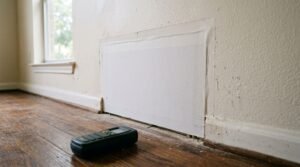

Houston has one of the largest renter populations of any major Texas city, and apartment mold is a year-round concern in this climate. Roughly 60 percent of Houston households rent, which means hundreds of thousands of tenants live with the specific challenges of apartment mold: shared HVAC systems, slab construction, hidden moisture, and a landlord-tenant dynamic that often determines whether the problem gets fixed. This guide walks through how to test for mold in your Houston apartment, how to document what you find, and when to bring in independent help.
Important: This is general information, not legal advice. Tenant-landlord situations turn on specific facts and timing. For the full legal framework, our guide on Texas renters’ mold rights covers what your landlord is legally required to do.
Where Does Mold Typically Show Up in a Houston Apartment?
Houston apartment mold has a few favorite hiding spots that don’t get checked enough. Mold needs moisture and a porous surface to grow, and apartment construction concentrates both of those in specific places. The most common spots to find mold in a Houston apartment:
- Under sinks. Kitchen and bathroom under-sink cabinets accumulate slow drips from supply lines and drain connections. The cabinet base is often particle board, which holds moisture and feeds mold growth.
- Bathroom walls and ceilings. Houston humidity plus poor ventilation makes bathrooms a top mold location. Check the ceiling above the shower, the grout, the corners near the tub, and behind the toilet.
- HVAC closets and around air handlers. Indoor air handlers in apartment HVAC closets often have drip pans that overflow or condensate lines that clog. Mold grows on the drywall around the unit and on the closet floor. Our guide on AC leak mold covers the diagnosis.
- Behind washer and dryer hookups. Slow leaks at the supply line connection or behind the washing machine itself can soak drywall for months before becoming visible at floor level.
- Window AC units in older Houston apartments. Many older Houston rental buildings still use window AC units. These produce significant condensation, and the wall area around the unit collects moisture that feeds mold growth.
- Window sills and frames. Wind-driven rain during tropical storms forces water past weatherstripping. The window sill and lower frame are prime spots for mold to bloom in the days following a storm event.
- Closet corners and exterior walls. Air conditioning can cause condensation on exterior walls in closets, especially in north-facing units. Closets with low airflow accumulate moisture against drywall.
- Carpet edges along baseboards. Slab leak moisture in ground-floor units wicks up through the carpet padding along the baseboard line.
Walking through each of these spots with a flashlight is the first practical step. Many apartment mold cases get solved at this stage because visible growth in one of these typical locations is hard for a landlord to dispute.
How Do I Document Mold in My Apartment?
Documentation matters more than testing in most apartment mold cases. A tenant with strong documentation often gets the issue addressed quickly. A tenant with weak documentation often spends months arguing with the property manager. The documentation checklist:
- Date-stamped photos and video. Take wide shots showing the location in the apartment, then close-ups of the actual growth. Include a ruler or coin in frame for scale where possible. Most smartphones embed timestamps automatically.
- Written notice to the landlord. Texas Property Code §92.052 requires landlord repair duties to be triggered by written notice. Certified mail with return receipt is the safest format. Texts and emails alone often don’t satisfy the legal standard.
- Log of all communications. Keep dated copies of every text, email, and voicemail about the mold. If the property manager calls, follow up with an email summarizing the call so you have a paper trail.
- Moisture-source notes. Document what you think is causing the moisture, such as a leaking pipe, a roof leak after a storm, or a clogged AC drain. This information speeds up the diagnosis when an inspector arrives.
- Medical records if applicable. If anyone in the apartment has been seen by a doctor for symptoms that may be related to mold exposure, save the medical records. This is not medical advice. Talk to a physician about symptoms.
- Any prior repair history. Records of previous water leaks, roof repairs, or mold work on the unit strengthen the case that the moisture issue isn’t tenant-caused.
Strong documentation is what turns a he-said-she-said dispute into something a property manager, a city housing inspector, or a judge can act on.
Can I Test for Mold in My Apartment Myself?
DIY mold test kits exist, and you can buy them at most hardware stores for $30 to $80. The honest answer about whether they help: not much, for the situations that matter.
Most DIY kits use settle plates, which let mold spores fall onto a petri dish over a few hours. The result is “mold is present,” which is true everywhere on Earth. The kits don’t measure spore concentration, don’t compare indoor levels to an outdoor baseline, and don’t identify species with the accuracy a real lab does.
More importantly, DIY results are not accepted as documentation by:
- Property managers responding to repair requests
- Insurance companies handling claims
- Texas justice courts in repair-and-remedy lawsuits
- Real estate disclosure processes if you eventually move out and need to certify the unit’s condition
For curiosity-level “is there mold somewhere in this apartment” questions, a DIY kit can give you a directional answer. For any situation where the result needs to hold weight against a landlord, an insurance adjuster, or a court, a DIY kit is not the right tool. The CDC notes that good sampling for mold can be expensive and there are no set standards for what counts as an acceptable quantity, which is why interpretation by a licensed assessor matters as much as the test itself.
When Should I Bring in an Independent Mold Tester?
An independent mold inspection is the right move in these scenarios:
- The landlord disputes the existence of mold. If you’ve sent notice and the property manager says “that’s not mold” or “there’s no problem here,” an independent licensed assessor settles the question. A TDLR-licensed report is hard for a landlord to ignore.
- Symptoms in the home but no visible mold. If you or family members are experiencing respiratory symptoms, persistent allergy issues, or headaches that improve when you leave the apartment, air sampling can identify hidden mold even when nothing is visible.
- You’re weighing your options if the landlord won’t act. Texas law gives tenants formal paths if a landlord refuses to address mold, and any of those paths benefit from an independent inspection report as documentation. The inspection itself is often what resolves the situation before formal steps become necessary.
- Security deposit or move-out documentation. If you’re worried about a future dispute over the unit’s condition, an independent inspection creates a defensible record of what the conditions actually were.
- The landlord hired their own inspector and you don’t trust the result. A property-manager-hired inspector has a built-in conflict of interest. An independent inspector with no relationship to the landlord gives you a second opinion that any neutral reviewer will respect.
The common thread: any situation where the result needs to hold up against pushback from someone with a financial interest in the outcome.
What Does an Apartment Mold Inspection Cover?
A typical apartment mold inspection in Houston takes one to two hours on site. The inspector starts with a walk-through of the unit, focusing on the high-probability spots listed earlier. From there, moisture meters confirm whether walls, baseboards, and floor materials have elevated moisture content. Thermal imaging catches hidden moisture behind drywall.
Sampling typically includes:
- Air samples from the affected room and from at least one outdoor location for comparison baseline
- Surface samples on any visible suspect mold, collected by tape lift or swab
- HVAC sample if there’s reason to suspect the apartment’s air handler is contributing
Every sample goes to EMSL Analytical, an AIHA-LAP accredited laboratory, and your written report is delivered within one business day of sampling. The report includes the spore count comparison against the outdoor control, species identification, moisture readings, photo documentation, and clear recommendations on whether remediation is needed.
Mold Testing Houston operates under TDLR Mold Assessment Company License ACO1245 as an independent assessment company. We perform inspection and testing only. We do not perform remediation. That separation is what makes our reports defensible in tenant disputes.
Pricing is a flat $550 for a standard residential inspection on units up to 2,500 square feet, covering the on-site visit, up to two lab-analyzed samples, and the written report. Additional samples are $85 each and we collect them only with your approval. The price is the same whether mold is found or not.
How Do I Present Mold Findings to My Landlord?
The way you present mold findings to a landlord can make the difference between fast resolution and weeks of stalling. A few practical guidelines that work well for Houston tenants:
Send the formal request in writing. Certified mail with return receipt, even if you also email a copy. Texas law often requires written notice with proof of delivery for repair duties to attach properly.
Lead with the documentation, not the threat. A reasonable opening message includes the photos, the inspection report if you have one, a clear description of the moisture source if known, and a specific request for repair. Open with cooperation, not confrontation. Most landlords respond better to “here’s what’s happening and what needs to be addressed” than to “fix this or I’m suing.”
State a clear timeline. Texas Property Code generally treats seven days as a reasonable repair window after written notice. Your message can reference this expectation without quoting statutes at the landlord.
Keep your end of the relationship clean. Stay current on rent. The repair duty under Texas law generally does not apply if the tenant is delinquent on rent at the time notice is given.
Escalate only if necessary, and in writing. If the landlord does not respond or refuses to act, the next steps are typically a second written notice followed by a formal complaint to the appropriate city or state agency. Most situations resolve before that point if the documentation is clear and the inspection report is solid.
What Are My Options if My Landlord Won’t Address the Mold?
If documentation, written notice, and reasonable cooperation don’t get the issue addressed, Texas law gives tenants formal paths to escalate. These mechanisms have specific procedural requirements, and the right path depends on the particulars of your situation. The common thread: an independent licensed mold inspection report is the strongest single piece of evidence you can put on the table, regardless of which path applies.
For the full legal framework on what your landlord must do under Texas law and what remedies are available to a tenant, our guide on Texas renters’ mold rights walks through the options and the procedural requirements that come with each. If you’re at the point of considering formal escalation, that guide is the right next read.
Frequently Asked Questions
How do I check my apartment for mold without testing equipment?
Walk through the apartment with a flashlight checking the high-probability locations: under sinks, in bathrooms including the ceiling, grout, and corners, in HVAC closets, behind washer and dryer hookups, around window AC units, on window sills and frames, in closet corners, and along baseboards on exterior walls. Look for visible growth, water staining, and bubbling or peeling paint. Note any persistent musty smell. Photograph anything you find.
How serious is mold in an apartment?
It depends on the source and the extent, not on how alarming it looks. A small patch of surface growth on bathroom grout is a cleaning problem. Growth spreading from a plumbing leak inside a wall cavity is a repair problem your landlord owns, and it will keep returning until the water is fixed. The seriousness question is really a moisture question, which is why an assessment traces the source rather than just confirming that mold exists. Health concerns should go to a physician, not to a mold inspector.
How can I tell if mold is behind drywall?
You usually cannot see it, so you look for the conditions instead. A persistent musty smell with no visible source, staining or bubbling paint at the bottom of a wall, baseboards that feel soft or have separated slightly, warped flooring along one wall, and a section of wall that feels cooler than the rest are all indicators. A moisture meter reads elevated moisture content through the surface, and thermal imaging shows the temperature differential that wet material creates. Confirming it takes a small borescope hole to look directly into the cavity, which a tenant should not do without landlord permission.
Does turning the AC off cause mold?
In Houston, yes, and it is a common cause in apartments left vacant or with the AC set high to save money. Air conditioning removes humidity as well as heat. With the system off during a Houston summer, indoor relative humidity climbs into the range where mold grows on surfaces without any leak involved. Closets, bathrooms, and rooms with poor airflow go first. Setting the thermostat to 78 or 80 while you are away costs far less than remediation, and it keeps the system cycling enough to pull moisture out of the air.
Can I be evicted for reporting mold in my apartment?
Texas law prohibits landlord retaliation against tenants who exercise their legal rights in good faith. Texas Property Code §§92.331 to 92.335 provides protection for six months from the date of the complaint. A tenant facing eviction shortly after reporting mold should consult a Texas tenant attorney immediately.
Does my landlord have to pay for mold testing?
Texas law does not require the landlord to pay for independent mold testing initiated by the tenant. However, the cost of an independent assessment can sometimes be recovered as part of a settlement or resolution once the issue is formally addressed. Tenants typically pay upfront for the inspection and pursue reimbursement after the situation is resolved.
How long does it take to get apartment mold test results?
The on-site inspection takes one to two hours. Samples then go to EMSL Analytical, an AIHA-LAP accredited laboratory, and your written report is delivered within one business day of sampling. A Friday inspection means Monday results.
What does apartment mold testing cost in Houston?
Mold Testing Houston charges a flat $550 for a standard residential mold inspection, which applies to apartments as well as single-family homes. The flat rate covers the on-site inspection, moisture readings, up to two lab-analyzed air and surface samples, EMSL Analytical lab analysis, and the written report. Additional samples are $85 each with your approval. Pricing is the same whether mold is found or not.
Can the property manager refuse to let an independent inspector into my apartment?
A tenant generally has the right to bring guests and contractors into the unit, including a licensed mold inspector. The lease may have notification requirements for non-resident entry, but blanket refusal by a property manager is unusual. If a property manager attempts to block an inspection, document the refusal in writing and consult a Texas tenant attorney.
Get an Independent Apartment Mold Inspection in Houston
If you’re a Houston renter dealing with mold and need an inspection that holds up against your landlord, your insurance, or a justice court, Mold Testing Houston provides the independent assessment that property-manager-hired inspectors can’t match. We’ve served Houston since 2017 under TDLR Mold Assessment Company License ACO1245. We perform mold inspection and testing only, and we never bid on remediation. That independence is exactly what makes our reports defensible in tenant disputes.
Call 832-838-9387 or book your inspection online to get a clear picture of what’s actually in your unit and the documentation you need to act on it.